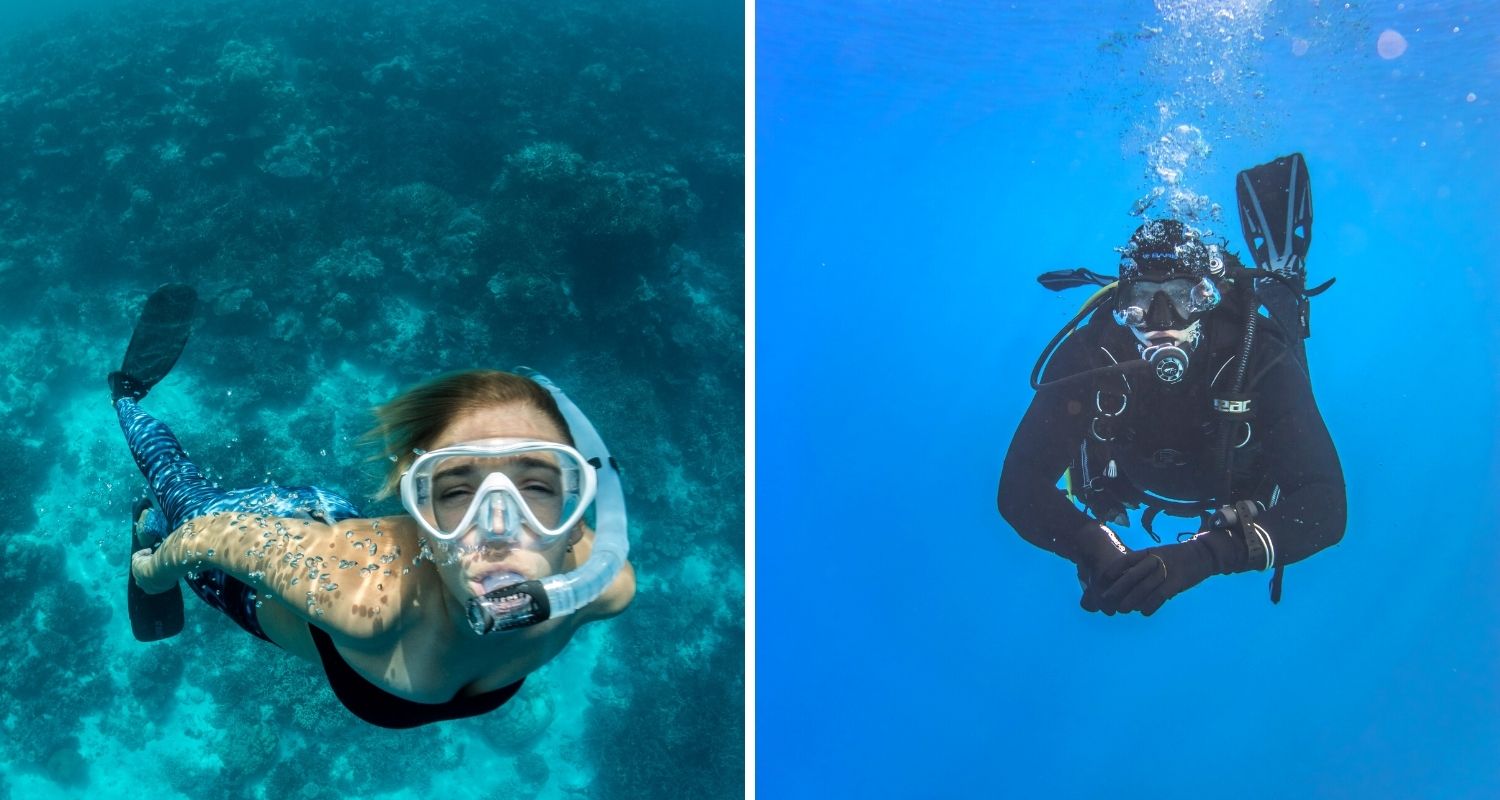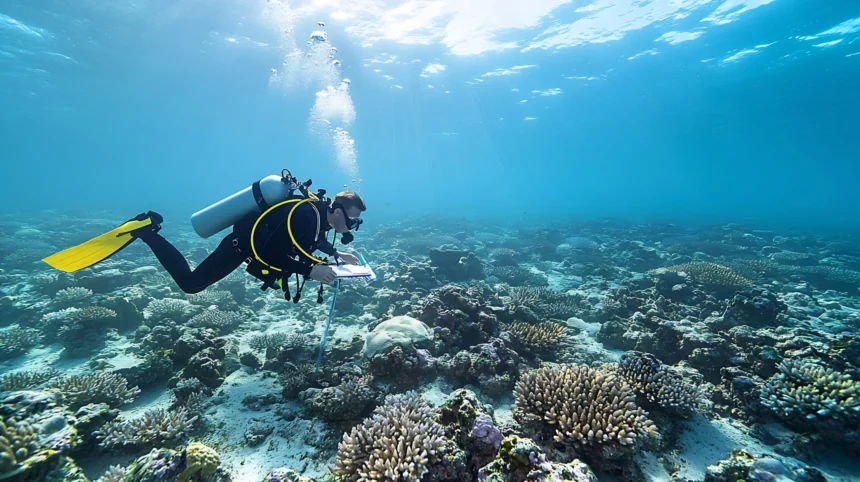
The moment you recognise something on a dive — when a shape in the blue resolves into a specific species you can name — the underwater world transforms. You stop seeing ‘fish’ and start seeing animals. You stop experiencing a blur of colour and start reading an ecosystem.
- How to Observe and Identify Marine Life Underwater
- Reef Fish: The Most Common Species Encountered by Recreational Divers
- Sharks: Diver’s Identification Guide
- Rays: The Underwater Fliers
- Sea Turtles: How to Tell the Five Common Species Apart
- Dangerous Marine Life: What Actually Poses Real Risk to Divers
- CONCLUSION
Marine life identification is one of the most rewarding skills a diver can develop over time. This guide covers the essential species groups every diver will encounter, with identification features, habitat notes, and behaviour tips developed from 10+ years of underwater observation across five oceans.
How to Observe and Identify Marine Life Underwater
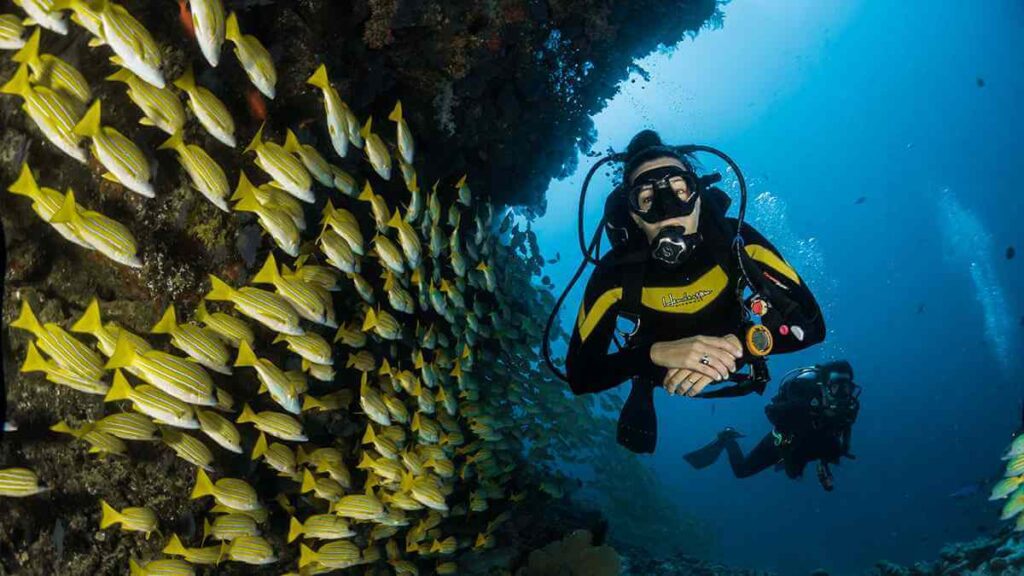
Before we dive into specific species, here’s how to observe and identify marine life effectively during your dives:
- Slow down: Move slowly and deliberately. Marine animals are vastly more likely to approach curious, still divers than those who rush through the water.
- Note key features: Body shape, fin configuration, colour pattern, size, and behaviour are your primary identification tools — in that order of reliability.
- Context matters: Note depth, substrate type (sand, coral, rock, open water), and proximity to reef structure. Species occupy distinct ecological niches.
- Use a slate: Sketch distinctive features during the dive for post-dive ID. The Seek by iNaturalist app (free) can confirm identifications from your sketches and photos.
- Never touch: Contact with marine life stresses the animal and can injure you (fire coral, lionfish spines, stonefish venom).
Reef Fish: The Most Common Species Encountered by Recreational Divers
Clownfish (Anemonefish — Family Amphiprioninae)
Found exclusively within the tentacles of host sea anemones, clownfish (made globally famous by the film ‘Finding Nemo’) have a mutualistic relationship with their anemone — protected by its stinging cells while cleaning and feeding it. 28 species exist globally; most are orange/white banded (Common Clownfish, Amphiprion ocellaris). Found throughout the Indo-Pacific; absent from the Caribbean and Atlantic entirely.
Butterflyfish (Family Chaetodontidae)
Disc-shaped, laterally compressed fish with bright patterning that typically includes ‘eyespots’ near the tail to confuse predators about which end to attack. Most species are monogamously paired for life — seeing a lone butterflyfish is unusual and indicates a recently widowed individual. Their presence is a positive indicator of healthy coral reef — they are one of the first species to disappear from degraded reefs.
Angelfish (Family Pomacanthidae)
Similar to butterflyfish but larger, with a distinctive spine at the gill cover (preopercular spine) that distinguishes the family. The most striking feature: juveniles of many species look completely different from adults. The Emperor Angelfish (Pomacanthus imperator) is a classic example — the juvenile displays concentric blue and white circles, while the adult is a dramatically different pattern of yellow and blue horizontal stripes.
Surgeonfish and Tangs (Family Acanthuridae)
Torpedo-shaped fish with a scalpel-sharp retractable spine at the base of the tail — used defensively and capable of cutting a careless handler. Blue tang (Paracanthurus hepatus — ‘Dory’ from Finding Nemo) and yellow tang are the most recognisable species. Surgeonfish are important reef ecosystem engineers, grazing algae and maintaining reef health.
Triggerfish (Family Balistidae)
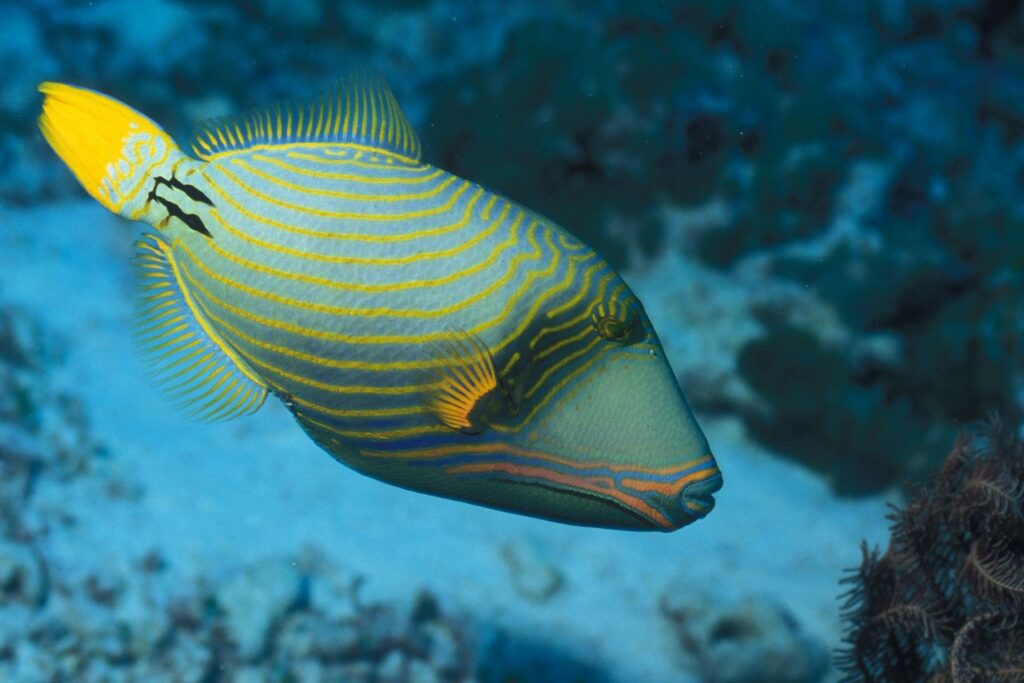
Tough, oval-bodied fish with a unique trigger spine system — the first dorsal spine locks upright and can only be released by depressing the shorter second spine, allowing the fish to lock itself into crevices and resist extraction by predators. Important behavioural note for divers: the Titan Triggerfish (Balistoides viridescens) in the Indo-Pacific is territorially aggressive and will charge divers who approach its conical nest on the substrate. If charged: swim horizontally away, never upward — the territory is cone-shaped and extends toward the surface above the nest.
Sharks: Diver’s Identification Guide
Sharks are one of the most sought-after sightings on any dive, and one of the most ecologically misrepresented animals in human culture. Here are the species recreational divers most commonly encounter:
Whitetip Reef Shark (Triaenodon obesus)
Slender, with unmistakable white tips on the dorsal and upper caudal fins. Maximum length approximately 2.1 metres. Often seen resting on the reef substrate or under coral ledges during the day (they are primarily nocturnal hunters). Extremely common in the Indo-Pacific; one of the least threatening shark species to divers. Will not approach aggressively when simply observed from a respectful distance.
Blacktip Reef Shark (Carcharhinus melanopterus)
Similar profile to whitetip but with black-tipped fins and a slightly more robust build. Highly recognisable and one of the most photogenic shark species for underwater photographers. Prefers shallow reef environments, lagoons, and passes — often seen in groups. Common throughout tropical Indo-Pacific and increasingly in the Mediterranean due to warming seas.
Grey Reef Shark (Carcharhinus amblyrhynchos)
Stockier build than the previous two species, grey colouration with a white underside and distinctive black posterior edge to the tail. Often encountered in groups patrolling reef walls and channels, particularly at dawn and dusk. Important threat display to recognise: if a grey reef shark hunches its back, depresses its pectoral fins, and begins an exaggerated lateral swimming motion — this is a pre-attack warning. Back away slowly and calmly. Do not flee rapidly.
Nurse Shark (Ginglymostoma cirratum)
Bottom-dwelling, slow-moving, with two distinctive barbels (fleshy whisker-like sensory organs) near the mouth used for detecting prey in sediment. Nocturnal hunters; most commonly seen by divers resting under coral ledges or in caves during daylight hours. Generally very docile and uninterested in divers. Caribbean and tropical Pacific.
Whale Shark (Rhincodon typus)
The world’s largest fish — reaching up to 12 metres and 18 tonnes. A completely harmless filter feeder, consuming plankton, fish eggs, and small schooling fish with their enormous mouths while swimming slowly at or near the surface. One of the most extraordinary wildlife encounters available to any recreational diver or snorkeller. Key identification: checkerboard pattern of white spots and stripes on dark grey skin.
Rays: The Underwater Fliers
Manta Ray (Mobula birostris — Oceanic; M. alfredi — Reef)
The largest rays in existence — oceanic mantas reach wingspans of up to 7 metres; reef mantas up to 5 metres. Both species are completely harmless — no tail spine. Identified by their distinctive cephalic fins (horn-like projections flanking the mouth, used to funnel plankton). Often seen at cleaning stations where small wrasse remove parasites from their gill plates and skin.
Eagle Ray (Aetobatus narinari and related species)
Distinctive spotted pattern on a dark upper surface, with a long, whip-like tail. Often seen in formation, gracefully ‘flying’ in open water above the reef. Not aggressive toward divers. Can leap completely out of the water — thought to be related to parasite removal or courtship behaviour.
Blue-Spotted Ribbontail Ray (Taeniura lymma)
One of the most beautiful and commonly encountered rays in the Indo-Pacific. Bright blue spots on a tan/orange body, with a relatively short tail bearing venomous spines. Will not attack divers but the tail spine is used defensively — the ‘stingray shuffle’ (sliding feet when walking in shallow water) prevents accidental encounters when entering the water from the beach.
Sea Turtles: How to Tell the Five Common Species Apart
Green Sea Turtle (Chelonia mydas)
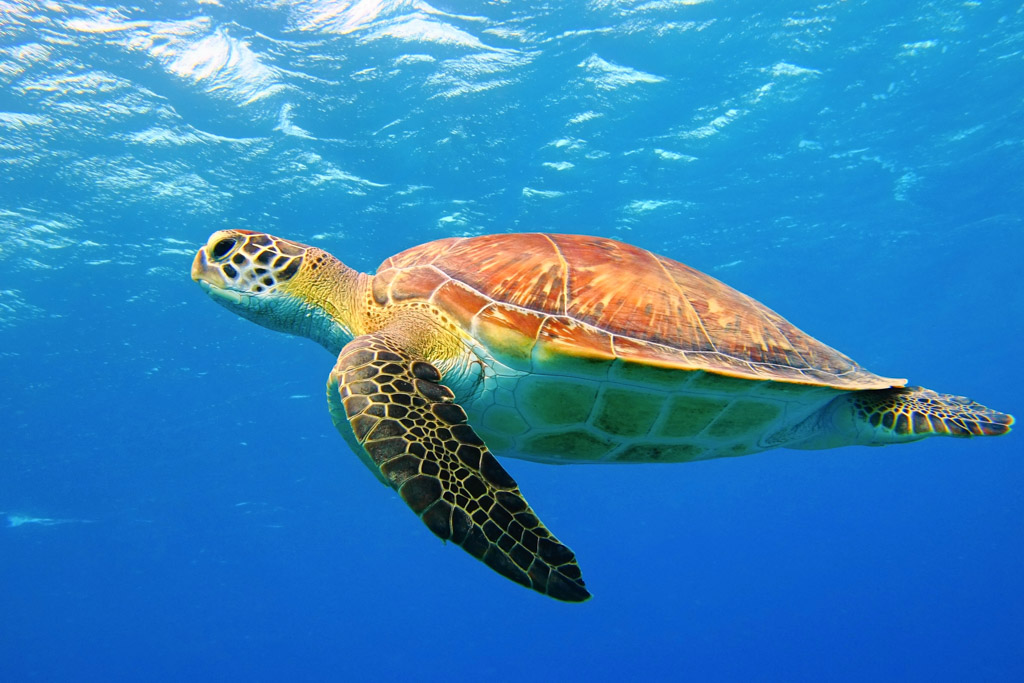
The most frequently encountered sea turtle species for scuba divers globally. Named not for their shell colour (which is olive/brown) but for the colour of their fat. Distinguished by a smooth, heart-shaped shell with four costal scutes and a small head relative to body size. Often seen grazing on seagrass beds or resting on reef structures. Growing populations in protected areas like the Great Barrier Reef, Maldives, and Galapagos are a genuine conservation success story.
Hawksbill Sea Turtle (Eretmochelys imbricata)
Narrower head with a distinctive pointed, curved beak (giving the species its name) specifically adapted for extracting sponges from reef crevices. Shell has overlapping scutes with beautiful amber/tortoiseshell patterning. Unfortunately critically endangered primarily due to historical shell trade. Often seen near coral reefs, hovering and probing crevices for sponges.
Loggerhead Sea Turtle (Caretta caretta)
The largest-headed of all sea turtle species, with massive powerful jaws specifically evolved for crushing hard-shelled prey — crabs, molluscs, and sea urchins. Reddish-brown shell. Common in the Mediterranean, Atlantic, and Pacific. One of the world’s most threatened sea turtle species due to longline fishing bycatch and beach development affecting nesting sites.
Dangerous Marine Life: What Actually Poses Real Risk to Divers
The most dangerous marine animals are rarely the ones most feared by non-divers. Here is a realistic risk ranking:
Stonefish (Synanceia species) — Highest Priority
The most venomous fish in the world. Masters of camouflage — they look exactly like a reef-encrusted rock sitting on the seabed. The venom, delivered through 13 dorsal spines, causes intensely painful wounds that can be life-threatening without prompt medical treatment (hot water immersion and antivenom). Prevention: never place hands or knees on the substrate without looking carefully first.
Lionfish (Pterois species) — Moderate Risk
Spectacularly beautiful with elaborate fin rays and bold striping. (Lionfish)Venomous spines cause intense localised pain for several hours — rarely life-threatening in healthy adults but requiring medical attention. Will not approach or pursue divers — only stings if accidentally contacted. Also an extremely damaging invasive species in the Caribbean and Mediterranean, where they have no natural predators.
Fire Coral (Millepora species) — Common Risk
Not a true coral but a hydrozoan colony. Contact causes immediate intense burning and stinging, followed by an itchy rash. Mustard/tan colouration; found encrusted on reef structures, often resembling ordinary hard coral. Wearing a full wetsuit prevents virtually all accidental contact.
Cone Snail (Conus species) — Severe Risk if Handled
Beautiful, attractively patterned cone-shaped shells containing a radula (tooth-like structure) that fires a venomous harpoon capable of penetrating a wetsuit. Several Indo-Pacific species (particularly the Geography Cone, Conus geographus) are potentially lethal. Simple rule: never pick up a cone snail regardless of how attractive the shell appears.
CONCLUSION
Marine life identification transforms every dive from a sensory experience into an educational one. The more you recognise, the richer every dive becomes — and the more deeply you appreciate what the ocean contains and what is at stake if we fail to protect it. Start with the common species in your dive region. Build your knowledge with a regional fish ID book, the Seek by iNaturalist app, or the PADI Fish Identification specialty. The ocean never runs out of new things to show you.