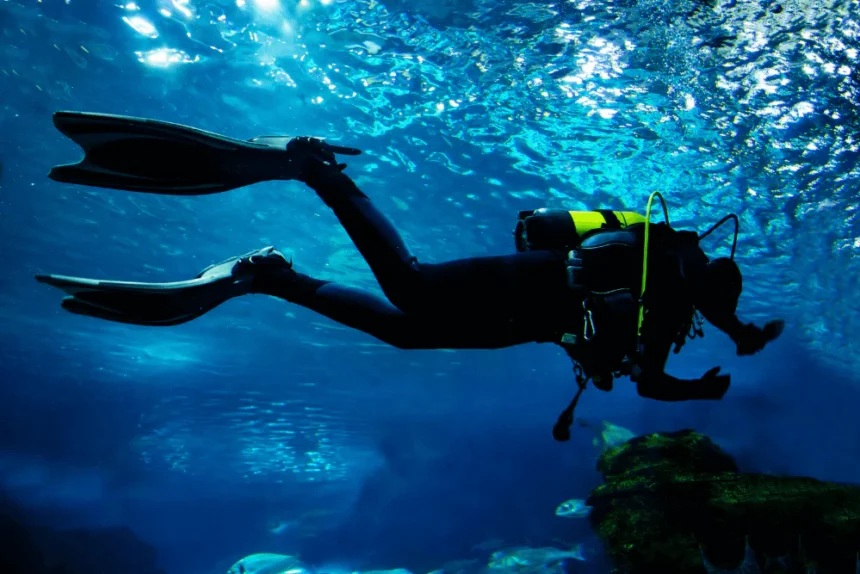
If you are planning your first dive or just getting curious about scuba diving, one of the first questions that pops into your head is a very simple one: how long does a scuba tank last? It sounds like a simple question but the honest answer depends on a few things, including your body size, how deep you dive, how relaxed you are underwater, and the size of your tank.
- What Is Inside a Scuba Tank?
- How Long Does a Scuba Tank Last on Average?
- Factors That Affect How Long Your Scuba Tank Lasts
- Scuba Tank Duration by Depth: A Practical Guide
- How to Make Your Scuba Tank Last Longer
- How to Read Your Scuba Pressure Gauge
- What Happens When You Run Low on Air?
- Ready to Dive Deeper Into Scuba Knowledge?
- Frequently Asked Questions
- Final Thoughts: Know Your Air, Enjoy Your Dive
In this guide, we are going to break down everything in a way that is easy to understand. By the end of this article, you will know exactly what to expect from your air supply on any dive, and how to make your tank last longer too.
What Is Inside a Scuba Tank?
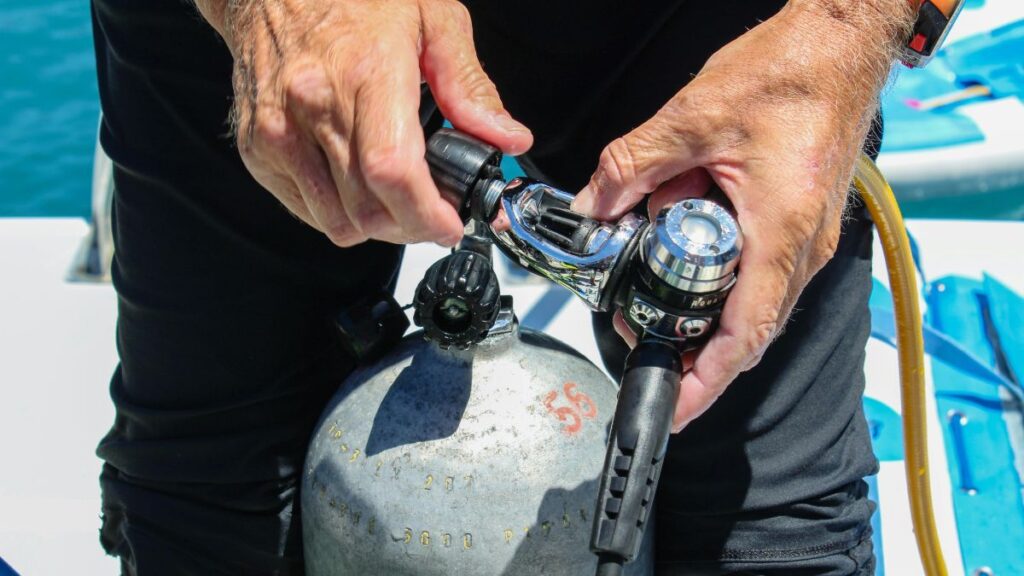
Before we talk about how long a scuba tank lasts, it helps to understand what is actually inside it. Most recreational scuba tanks are filled with regular compressed air, which is the same air we breathe every day but squeezed into a small metal cylinder at very high pressure.
A standard aluminum 80 scuba tank, which is the most commonly used tank for recreational diving, holds about 80 cubic feet of air compressed to around 3,000 psi (pounds per square inch). That might sound like a lot, but how quickly you use that air depends entirely on your breathing rate and the depth of your dive.
If you are also curious about how heavy these tanks feel before and after a dive, check out our detailed scuba tank weight chart to understand the full picture.
How Long Does a Scuba Tank Last on Average?
On average, a standard scuba tank lasts between 45 minutes and 60 minutes for most recreational divers. However, this number can go up or down quite a bit depending on several important factors that we will cover in detail below.
For experienced and relaxed divers who breathe slowly and efficiently, a single tank can sometimes last over 60 minutes, especially at shallower depths. For beginners who are nervous or breathing heavily, the same tank might run out in 30 to 40 minutes. This is perfectly normal and improves with practice and experience.
Factors That Affect How Long Your Scuba Tank Lasts
There are several key things that decide how long your air supply will last. Understanding these will help you plan your dives better and make the most of every underwater adventure.
1. Dive Depth
This is the single biggest factor. The deeper you go, the faster you use your air. This is because water pressure increases as you descend, and your regulator must deliver air at the same pressure as the surrounding water. At a depth of 33 feet (10 metres), the pressure doubles compared to the surface. At 66 feet, it triples.
What this means in practice is that the same tank that lasts 60 minutes at 15 feet might only last 20 to 25 minutes at 60 feet. This is why dive planning always includes a careful consideration of depth.
2. Your Breathing Rate (SAC Rate)
Your Surface Air Consumption rate, or SAC rate, measures how many cubic feet or litres of air you breathe per minute at the surface. A typical beginner has an SAC rate of around 0.8 to 1.2 cubic feet per minute. An experienced, relaxed diver might breathe as little as 0.4 to 0.6 cubic feet per minute.
Anxiety, heavy fins, a strong current, and cold water all cause you to breathe faster, which burns through your air supply much more quickly. Learning to stay calm and breathe slowly is one of the most valuable skills in diving, not just for safety but for extending your bottom time.
3. Tank Size and Type
Not all scuba tanks are the same size. A smaller aluminum 63 tank holds less air than an aluminum 80, and a larger steel 100 tank holds significantly more. If you are doing a deep dive or simply want more bottom time, opting for a larger tank is an easy solution.
Some technical divers use twin tanks or sidemount setups, which can extend dive time considerably. But for most recreational divers, a standard 80 cubic foot tank is perfect for a normal dive.
4. Your Body Size and Fitness Level
Larger people tend to have bigger lung capacity and use more air per breath. Similarly, people who are not physically fit may breathe harder during a dive, especially when swimming against a current. Regular exercise and cardiovascular fitness can genuinely help you get more bottom time from every tank.
5. Water Temperature
Cold water causes your body to work harder to stay warm, which means you breathe faster. If you are diving in cold conditions without a thick wetsuit or drysuit, you will likely burn through your air faster than in warm tropical waters. Always dress appropriately for the water temperature.
Scuba Tank Duration by Depth: A Practical Guide
To give you a practical sense of what to expect, here is a rough breakdown of how long a standard aluminum 80 scuba tank lasts at different depths for an average recreational diver with a SAC rate of around 0.75 cubic feet per minute.
At a depth of 10 feet, your tank can last well over 90 minutes because the pressure is barely higher than at the surface. At 33 feet, the most popular depth for reef dives and beginner courses, you can expect around 50 to 60 minutes. At 60 feet, a common recreational depth for wreck and wall dives, expect around 30 to 40 minutes. At the recreational limit of 130 feet, your tank may only last 15 to 20 minutes, which is why deep dives are kept short by design.
These numbers are estimates, and your actual experience may vary. Always plan conservatively and never push your tank to zero. The golden rule is to surface with at least 500 psi remaining in your tank.
How to Make Your Scuba Tank Last Longer
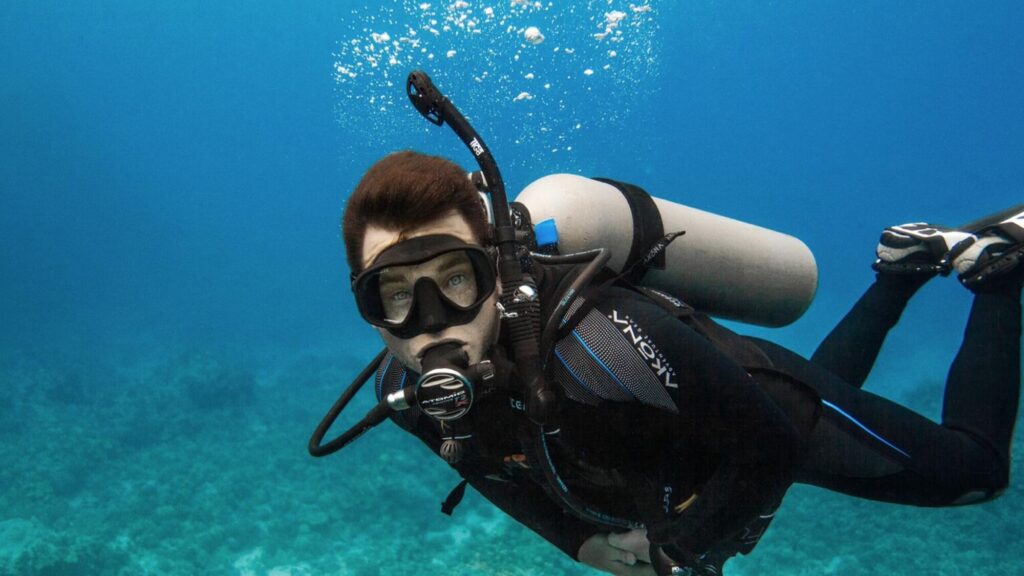
One of the most rewarding challenges in scuba diving is improving your air consumption so you can stay underwater longer. Here are some proven tips that will help you do exactly that.
Practice Slow, Controlled Breathing
Focus on breathing slowly and deeply rather than fast shallow breaths. Long, slow exhales are particularly effective. Think of it like practising yoga underwater. Every breath should be deliberate and relaxed. Shallow, fast breathing wastes air and does not deliver enough oxygen to your body efficiently.
Work on Your Buoyancy
Poor buoyancy control is one of the biggest air-wasting habits. When you are constantly kicking to stay at depth or using your BCD to compensate for bad trim, you burn through air far faster. Take a buoyancy speciality course if you can. Learning to hover effortlessly in the water is a game changer for both air consumption and enjoyment.
Streamline Your Body and Gear
Drag is your enemy underwater. Keep your arms close to your body, tuck in any dangling equipment, and make sure all your gear is properly secured. Good streamlining means your body moves through the water with less effort, which means less breathing and more bottom time.
Dive More Often
The single best way to improve your air consumption is simply to dive more. The more time you spend underwater, the more comfortable you become, and the slower you breathe. Anxious beginners always use more air than relaxed experienced divers. Experience builds confidence, and confidence leads to calmer breathing.
How to Read Your Scuba Pressure Gauge
Your submersible pressure gauge, or SPG, is one of the most important instruments you carry on a dive. It tells you exactly how much air remains in your tank at any given moment. Knowing how to read and respond to it can literally save your life.
Most tanks are filled to around 3,000 psi. A common rule taught in open water courses is the rule of thirds: use one third of your air going out, one third coming back, and keep one third as a safety reserve. However, many recreational dive operators use a simpler rule: turn around or head back up when your gauge reads 1,000 psi, and surface with at least 500 psi remaining.
Get in the habit of checking your gauge every few minutes during a dive. Many modern dive computers also display remaining air pressure when connected to a wireless transmitter, which makes monitoring even easier.
What Happens When You Run Low on Air?
Running low on air is something every diver will experience at some point, which is exactly why dive training covers it so thoroughly. If your gauge drops to 500 psi or below, you should begin your ascent immediately, following proper safety stop procedures at 15 feet for 3 minutes.
If you run completely out of air during a dive, your dive buddy becomes your lifeline. That is why the buddy system exists. Your buddy carries a spare regulator called an octopus, which you can breathe from during a controlled ascent to the surface. This is practised in every open water certification course and should feel natural to you before you ever dive.
The key message here is simple: never ignore your pressure gauge, never dive alone, and always plan your air use before you enter the water.
Ready to Dive Deeper Into Scuba Knowledge?
If you found this guide helpful, you will love the rest of our beginner-friendly content at Scoobadive Guide. We cover everything from choosing your first piece of gear to planning your dream dive trip. Whether you are a first-timer or a certified diver brushing up on skills, we have guides written specifically for you.
For a complete breakdown of scuba equipment weight, do not miss our scuba tank weight chart, which helps you understand how tank size affects both dive time and comfort in the water.
Frequently Asked Questions
How long does a scuba tank last for a beginner?
For a beginner, a standard 80 cubic foot scuba tank typically lasts between 30 and 50 minutes at recreational depths. Beginners tend to breathe faster due to excitement and anxiety, which uses more air. As you gain experience and learn to stay calm underwater, your tank will last considerably longer.
Can you run out of air while scuba diving?
Yes, it is possible, which is why monitoring your pressure gauge throughout every dive is an absolute must. Running out of air is almost entirely preventable with proper planning and attention. Always follow the rules taught during your open water course and never ignore a dropping pressure gauge.
How many dives can you get from one tank of air?
One tank is typically used for one dive. After a dive, you return the tank to be refilled before your next dive. Some very short, shallow dives might allow a second dive from the same tank if significant air remains, but this is not the norm. Dive operators always check tank pressure before assigning tanks to divers.
Does a bigger scuba tank always mean more dive time?
Yes, in general terms, a bigger tank holds more air and will give you more bottom time at the same depth. However, larger tanks are heavier and can affect your buoyancy. It is important to choose a tank that suits both your air consumption needs and your physical ability to manage the extra weight comfortably.
What is a good SAC rate for a recreational diver?
A good Surface Air Consumption (SAC) rate for a recreational diver is around 0.5 to 0.7 cubic feet per minute. Beginners are usually around 0.8 to 1.2 cubic feet per minute. With regular diving and proper breathing technique, most divers can bring this number down significantly over time, which results in longer and more enjoyable dives.
How deep can a beginner scuba diver go?
Beginners who have completed their Open Water Diver certification are cleared to dive to a maximum of 60 feet (18 metres) with a dive professional or buddy of equal or higher certification. The PADI Advanced Open Water certification allows dives to 100 feet, and most recreational divers never need to go beyond that.
Final Thoughts: Know Your Air, Enjoy Your Dive
Understanding how long a scuba tank lasts is not just useful knowledge, it is essential knowledge for any diver. Whether you are preparing for your first open water course or trying to squeeze more time out of every dive, the principles are always the same. Breathe slowly, dive shallow when you can, stay relaxed, and always watch your gauge.
The more you dive, the better you will get at managing your air. It is one of those skills that improves naturally with experience, and before long you will be the diver who surfaces with plenty of air left while everyone else is already on the boat.
Happy bubbles and safe dives from all of us at Scoobadive Guide!