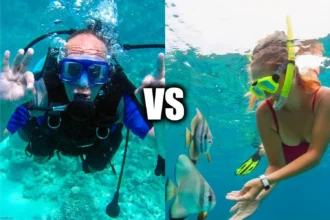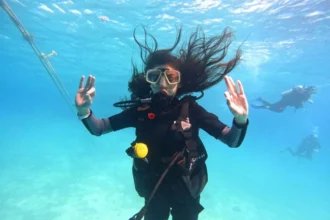
Scuba diving hand signals are the primary way recreational divers communicate underwater. Because divers cannot speak normally while breathing through a regulator, they use simple gestures to communicate with their dive buddy, share information, identify problems, and maintain safety.
- Why Are Hand Signals Important in Scuba Diving?
- 15 Essential Scuba Diving Hand Signals
- Quick Reference: Common Scuba Diving Hand Signals
- Are Scuba Diving Hand Signals Universal?
- How to Communicate Clearly Underwater
- Marine Life Hand Signals
- Frequently Asked Questions
- What is the most important scuba diving hand signal?
- What does a thumbs-up mean underwater?
- What does a thumbs-down mean in scuba diving?
- How do scuba divers communicate underwater?
- Are scuba diving hand signals the same worldwide?
- What does the low-air signal mean?
- What should I do if my dive buddy signals a problem?
- Do beginner scuba divers need to memorize all hand signals?
- Final Thoughts
The most important scuba diving hand signals include OK, ascend, descend, stop, something is wrong, low on air, out of air, and follow me. Learning these signals before your dive helps you communicate clearly and respond appropriately when underwater.
Whether you are preparing for your first scuba diving experience or refreshing your knowledge before your next dive, this guide explains 15 essential underwater hand signals, what they mean, and when to use them.
Why Are Hand Signals Important in Scuba Diving?
Communication is an essential part of safe scuba diving. Underwater, divers cannot rely on spoken words, so they need a communication system that works in different environments, visibility conditions, and situations.
Scuba diving hand signals allow you to:
- Check whether your dive buddy is okay.
- Communicate breathing gas information.
- Indicate that you want to ascend or descend.
- Alert another diver to a problem.
- Point out marine life.
- Communicate directions.
- Signal when you need to stop or change the dive plan.
Most recreational divers learn a core set of hand signals during their certification training. However, some signals may vary between diving organizations, countries, dive operators, and individual dive teams.
That is why you should always review the signals with your buddy during your pre-dive briefing.
15 Essential Scuba Diving Hand Signals
1. OK – Are You Okay?
The OK signal is one of the most important underwater communication signals.
How to make the signal:
- Touch your thumb and index finger together to form a circle.
- Extend your remaining fingers.
- Hold the signal where your buddy can clearly see it.
This signal can mean “I am okay” or “Are you okay?” depending on the context.
When your buddy asks whether you are okay, respond with the same signal if everything is fine.
If you are experiencing discomfort, anxiety, equipment problems, or another issue, do not signal OK simply because you feel pressured to continue the dive.
2. Something Is Wrong
This signal communicates that you are experiencing a problem and need your buddy’s attention.
A commonly used signal involves holding your hand flat with the palm facing down and moving it back and forth.
You can follow the problem signal with another gesture to explain the issue.
For example:
- Point to your ear if you are having difficulty equalizing.
- Point to your regulator if you have a breathing-related concern.
- Point to your chest if you feel uncomfortable.
- Point toward your equipment if something is malfunctioning.
If your buddy gives this signal, stop and assess the situation instead of continuing the dive.
3. Ascend – Go Up
The ascend signal is made by extending your thumb upward.
Underwater, a thumbs-up does not mean “great” or “everything is good.” It means that you want to go up or ascend.
Use this signal when:
- You have reached your planned turnaround point.
- You want to end the dive.
- You are uncomfortable.
- You have a problem that requires ending the dive.
- Your dive buddy indicates that the dive should end.
Always follow your training and dive plan when ascending.
4. Descend – Go Down
The descend signal is made by extending your thumb downward.
It communicates that you want to descend to a deeper depth.
Before descending, make sure your buddy understands the signal and is ready to follow.
Divers should descend in a controlled manner and maintain appropriate buoyancy and equalization.
5. Stop – Wait
The stop signal is commonly made by holding your hand vertically with the palm facing the other diver.
This tells your buddy to stop moving and wait.
You might use this signal when:
- You need to check your equipment.
- You want to pause for a marine-life observation.
- You need to reorganize your dive group.
- You want to assess a situation before continuing.
A stop signal should be taken seriously. Do not continue swimming until you understand why your buddy is asking you to stop.
6. Follow Me
The follow-me signal indicates that you want your buddy or dive group to follow your direction.
It is commonly made by gesturing toward yourself and then indicating the direction in which you intend to swim.
Before changing direction, make sure your buddy understands where you are going.
This is especially important when diving around reefs, wrecks, underwater structures, or areas with limited visibility.
7. Look
The look signal directs another diver’s attention toward something.
A common version involves pointing two fingers toward your eyes and then pointing toward the object or direction you want your buddy to observe.
Divers use this signal to point out:
- Marine animals.
- Interesting coral formations.
- Underwater structures.
- Potential hazards.
- Other divers.
Always make sure your buddy is looking at you before giving the signal.
8. Low on Air
The low-on-air signal commonly involves making a fist and moving it toward your chest.
It communicates that your remaining breathing gas has reached a predetermined low-air threshold.
When your buddy signals low on air:
- Acknowledge the signal.
- Check your own gas supply.
- Follow the agreed dive plan.
- Begin the appropriate ascent and safety procedures.
Low on air is not necessarily an emergency, but it requires an appropriate response.
Never ignore a low-air signal from your dive buddy.
9. Out of Air
The out-of-air signal is an emergency communication signal.
A commonly used version involves moving a flat hand across the throat.
It indicates that the diver cannot continue breathing from their current gas supply.
If your buddy signals out of air, immediately follow the emergency procedures taught during your scuba certification course.
This may involve providing an alternate air source and conducting a controlled ascent with your buddy.
Do not wait to see whether the problem resolves itself.
10. How Much Air Do You Have?
Divers commonly ask about breathing gas by pointing toward their pressure gauge.
Your buddy can then show the remaining pressure using agreed hand signals or their own gauge.
Because numerical hand signals can vary, it is important to establish how your dive team will communicate gas pressure before entering the water.
For example, agree on:
- How you will indicate hundreds of pressure units.
- How you will indicate tens.
- Whether you will use fingers or another method.
- What pressure will trigger the end of the dive.
11. Safety Stop
A safety stop is commonly performed near the end of a recreational dive when conditions and the dive plan allow.
Divers may use a combination of signals to communicate the safety stop, including indicating the number three and showing a horizontal hand position.
The exact signal can vary between dive teams.
Before your dive, ask your instructor or guide how the safety stop will be communicated.
A safety stop is not a substitute for proper dive planning or required decompression procedures.
12. Ear Problem
If you experience difficulty equalizing your ears, point toward your ear to communicate the problem.
You may also use the general problem signal.
Your buddy should understand that you need to stop descending.
Never continue descending while experiencing ear pain or pressure that you cannot comfortably equalize.
If the problem continues, follow your training and end the dive when necessary.
13. Slow Down
The slow-down signal is commonly made by extending your hand with the palm facing downward and moving it gently up and down.
Use this signal when your buddy:
- Is swimming too quickly.
- Is moving away from the group.
- Needs to control their breathing.
- Is ascending or descending too rapidly.
- Needs to improve their buoyancy.
Slow and controlled movements are important for safe scuba diving.
14. Turn Around
The turn-around signal communicates that you want the dive team to reverse direction.
Divers may use a directional gesture or an agreed signal during the briefing.
This signal is particularly important when:
- You have reached the planned turnaround point.
- Your breathing gas is approaching the agreed limit.
- Conditions have changed.
- You need to return toward the exit point.
Always follow the dive plan and communicate changes clearly.
15. Help or Emergency
A diver who needs assistance should use the appropriate emergency signal taught during their training.
The exact signal may depend on whether the diver is underwater or at the surface.
If you see a diver signaling distress:
- Maintain awareness of your own safety.
- Respond according to your training.
- Communicate with other members of the dive team.
- Follow established emergency procedures.
Emergency signals should never be used casually or as jokes during a dive.
Quick Reference: Common Scuba Diving Hand Signals
| Hand Signal | Meaning |
|---|---|
| Thumb and index finger form a circle | OK / Are you okay? |
| Thumb pointing upward | Ascend |
| Thumb pointing downward | Descend |
| Vertical palm facing buddy | Stop |
| Flat hand rocking | Something is wrong |
| Fist moving toward chest | Low on air |
| Hand across throat | Out of air |
| Point toward eyes | Look |
| Point toward ear | Ear problem |
| Gesture toward yourself and direction | Follow me |
| Point toward pressure gauge | How much air? |
| Palm facing down, moving gently | Slow down |
| Directional gesture | Turn around |
| Three fingers or agreed safety-stop gesture | Safety stop |
Remember: Hand signals can vary. The meanings above describe commonly used recreational scuba signals, but you should confirm the exact signals with your instructor or dive buddy before every dive.
Are Scuba Diving Hand Signals Universal?
Many basic scuba diving hand signals are widely recognized around the world, especially signals for OK, ascend, descend, stop, low on air, and out of air.
However, not every signal is universal.
Differences may occur in:
- Marine-life signals.
- Number signals.
- Directional signals.
- Safety-stop signals.
- Instructor-specific signals.
- Technical diving communication.
- Regional diving practices.
For example, a marine-life signal used by one dive guide may not be familiar to another diver.
This is why a pre-dive briefing is essential.
Before entering the water, discuss the signals you will use and make sure every member of the dive team understands them.
How to Communicate Clearly Underwater
Knowing the signals is only the first step. You must also make sure your buddy can see and understand them.
1. Make Eye Contact First
Before giving a signal, make sure your buddy is looking at you.
If they are looking in another direction, gently attract their attention.
2. Make Signals Clearly
Avoid small or rushed movements.
Hold your hands away from your body and make deliberate gestures.
3. Confirm Important Messages
When your buddy asks a question, respond clearly.
For important communication, make sure the other diver acknowledges the signal.
4. Use a Dive Light at Night
During night dives, illuminate your hand signals carefully so your buddy can see them.
Avoid shining the light directly into another diver’s eyes.
5. Agree on Signals Before Diving
Review your basic communication signals during your pre-dive buddy check.
Discuss any additional signals that may be needed for the planned dive.
6. Carry an Underwater Slate
An underwater slate can help when hand signals are insufficient.
It is useful for communicating:
- Complicated equipment problems.
- Specific dive-plan changes.
- Marine-life identification.
- Directions.
- Questions that require a detailed answer.
Marine Life Hand Signals
Marine-life hand signals are a fun part of scuba diving because they allow divers to share underwater discoveries.
Divers may use hand gestures to identify animals such as:
- Sharks.
- Rays.
- Turtles.
- Octopuses.
- Lobsters.
- Moray eels.
- Lionfish.
- Seahorses.
However, marine-life signals are not always standardized.
If you are diving with a new buddy or guide, review the signals for animals you expect to see.
When identifying marine life, remember to maintain an appropriate distance and avoid touching, chasing, or disturbing animals.
Frequently Asked Questions
What is the most important scuba diving hand signal?
The OK signal is one of the most frequently used signals because divers use it to check and confirm their condition. Emergency signals such as low on air and out of air are also essential.
What does a thumbs-up mean underwater?
A thumbs-up means ascend or go up. It does not mean everything is okay underwater.
What does a thumbs-down mean in scuba diving?
A thumbs-down commonly means descend or go deeper.
How do scuba divers communicate underwater?
Divers primarily communicate using hand signals. They may also use underwater slates, dive lights, touch communication, rope signals, or specialized underwater communication equipment.
Are scuba diving hand signals the same worldwide?
Many basic signals are widely recognized, but some signals vary by region, dive organization, operator, or individual dive team. Always review signals before diving.
What does the low-air signal mean?
The low-air signal commonly involves moving a fist toward the chest. It tells your buddy that your breathing gas is approaching your agreed low-air threshold.
What should I do if my dive buddy signals a problem?
Stop, acknowledge the signal, and assess the situation. Follow your training and the dive plan. Do not ignore a problem signal or continue diving without understanding the issue.
Do beginner scuba divers need to memorize all hand signals?
Beginners should learn the core signals taught during their certification course, especially OK, problem, stop, ascend, descend, low on air, out of air, and follow me. Additional signals can be learned as diving experience increases.
Final Thoughts
Scuba diving hand signals are a simple but essential part of underwater communication.
Learning the basic signals helps you communicate with your buddy, understand your dive guide, recognize potential problems, and enjoy the underwater world with greater confidence.
Before every dive, review the signals you will use, confirm that your buddy understands them, and remember that clear communication is a shared responsibility.
Good divers do not simply know the signals. They use them clearly, respond appropriately, and never ignore a message that could affect their safety.
References
- PADI: Scuba Diving Hand Signals
- PADI: Effective Underwater Communication in Diving
- SCUBAPRO: Basic Scuba Hand Signals
- Recreational Scuba Training Council: Common Hand Signals for Recreational Scuba Diving
This article is for educational purposes and does not replace scuba certification, professional instruction, or your dive organization’s safety procedures.