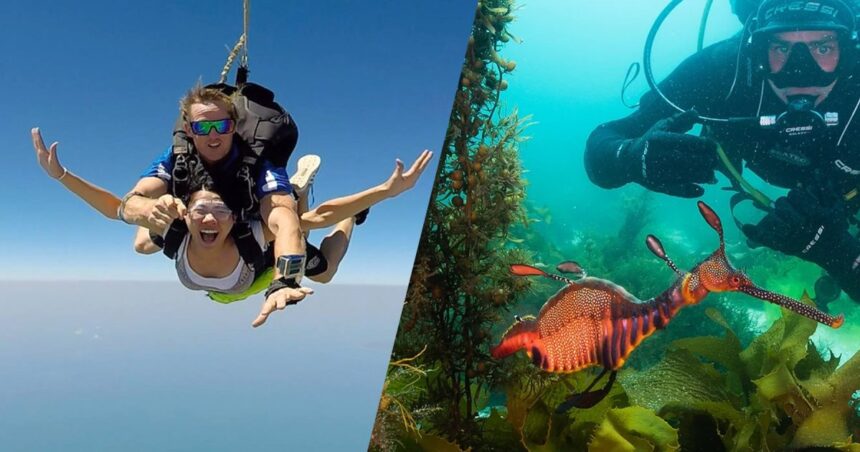
Adventure sports are becoming increasingly popular in the United States, and two of the most searched activities are scuba diving and skydiving. Both offer unmatched adrenaline and unforgettable experiences—but they also come with risks that many people don’t fully understand before booking a dive or a jump.
- Understanding the Nature of Both Activities
- Risk Comparison: Scuba Diving vs Skydiving
- Injury Types: Scuba Diving vs Skydiving
- Cost Risk: Which Accident Is More Expensive?
- Which Is Safer: Scuba Diving or Skydiving?
- Risk Factors That Increase Danger in Both Activities
- Which One Should You Choose?
- Final Verdict: Scuba Diving vs Skydiving
If you’re wondering “Is scuba diving safer than skydiving?”, or trying to compare injury risks, medical costs, and real-world safety, this detailed guide will give you a clear, honest comparison based on data, expert insight, and real-world scenarios.
This article breaks down scuba diving risks vs skydiving in a practical, easy-to-understand way so you can decide which adventure is right for you.
Understanding the Nature of Both Activities
Before comparing risks, it’s important to understand how these two activities differ at a fundamental level.
What Is Scuba Diving?
Scuba diving involves breathing compressed air underwater while exploring marine environments. It requires:
- Proper training and certification
- Equipment maintenance
- Controlled breathing
- Awareness of depth and pressure
Most recreational dives take place between 30–60 feet, though advanced divers go deeper.
What Is Skydiving?
Skydiving involves jumping from an aircraft at around 10,000–15,000 feet, free-falling for up to 60 seconds, and deploying a parachute before landing.
Skydiving relies heavily on:
- Equipment reliability
- Weather conditions
- Instructor expertise
- Emergency backup systems
Both activities are thrilling—but the type of risk involved is very different.
Risk Comparison: Scuba Diving vs Skydiving
Overall Risk Level
| Activity | Risk Level | Nature of Risk |
|---|---|---|
| Scuba Diving | Moderate | Gradual, medical-related |
| Skydiving | Low–Moderate | Sudden, equipment-related |
According to safety data and industry studies:
- Scuba diving injuries often happen due to poor training, health conditions, or improper ascent.
- Skydiving injuries are rarer but can be severe if equipment fails or landing is mishandled.
In terms of fatalities:
- Scuba diving accidents occur more frequently worldwide.
- Skydiving fatalities are statistically rarer but more dramatic when they occur.
Injury Types: Scuba Diving vs Skydiving
Common Scuba Diving Injuries
- Decompression sickness (the bends)
- Ear and sinus barotrauma
- Nitrogen narcosis
- Lung overexpansion injuries
- Equipment-related accidents
Most scuba injuries happen after the dive, especially due to improper ascent or ignoring safety stops.
Common Skydiving Injuries
- Ankle or leg fractures during landing
- Back injuries
- Parachute malfunction (rare)
- Hard landings due to wind conditions
Skydiving injuries usually occur during landing, not during freefall.
Cost Risk: Which Accident Is More Expensive?
This is where many people get surprised.
Scuba Diving Medical Costs (USA)
- ER visit: $1,500–$4,000
- Hyperbaric chamber treatment: $5,000–$20,000
- Hospital stay: $10,000+
- Ambulance or evacuation: $3,000–$15,000
Scuba-related medical emergencies can quickly become expensive, especially if evacuation is required from remote locations.
You can read more about dive-related safety and emergency considerations on this detailed guide from
👉 Scooba Dive Guide – Scuba Safety Resources
Skydiving Medical Costs
- Minor injuries: $1,000–$3,000
- Fractures: $5,000–$15,000
- Major trauma (rare): $25,000+
Most professional drop zones in the US require waivers and safety briefings, reducing risk significantly.
Which Is Safer: Scuba Diving or Skydiving?
To better understand how skydiving risks compare to underwater activities, it’s important to also look at real-world skydiving safety data. A detailed breakdown of skydiving risks, safety factors, and accident analysis is available on Skydive Guides, which explains how modern skydiving safety systems and training have significantly reduced fatality rates in recent years.
Statistically Speaking:
✔ Skydiving is slightly safer than scuba diving in terms of fatal accidents per participant.
✔ Scuba diving has more medical incidents, but most are non-fatal.
✔ Skydiving accidents are rarer but more severe.
Why Scuba Diving Feels Riskier
- Involves breathing underwater
- Requires constant awareness
- Health conditions play a major role
- Mistakes compound slowly
Why Skydiving Feels Riskier (But Often Isn’t)
- High altitude fear
- Fast descent
- Psychological fear factor
- Visual intensity
In reality, modern skydiving is highly regulated, while scuba diving safety depends more on the diver’s decisions.
Risk Factors That Increase Danger in Both Activities
For Scuba Diving:
- Poor physical fitness
- Skipping safety stops
- Diving while sick
- Inadequate training
- Cheap or unserviced equipment
For Skydiving:
- Bad weather
- Improper landing technique
- Ignoring instructor guidance
- Poor parachute packing
Which One Should You Choose?
Choose Scuba Diving If:
- You prefer slow-paced adventure
- You enjoy underwater exploration
- You’re physically fit and calm
- You want longer activity time
Choose Skydiving If:
- You want a one-time thrill
- You prefer structured safety systems
- You want minimal physical exertion
- You trust professional instructors
Final Verdict: Scuba Diving vs Skydiving
✔ Scuba diving has more medical risks but they are usually manageable.
✔ Skydiving has fewer accidents, but consequences can be serious.
✔ Both are safe when done with certified operators.
✔ Insurance and training play a major role in safety.
If safety is your top concern, skydiving slightly edges out scuba diving statistically.
If experience and duration matter more, scuba diving offers more control.