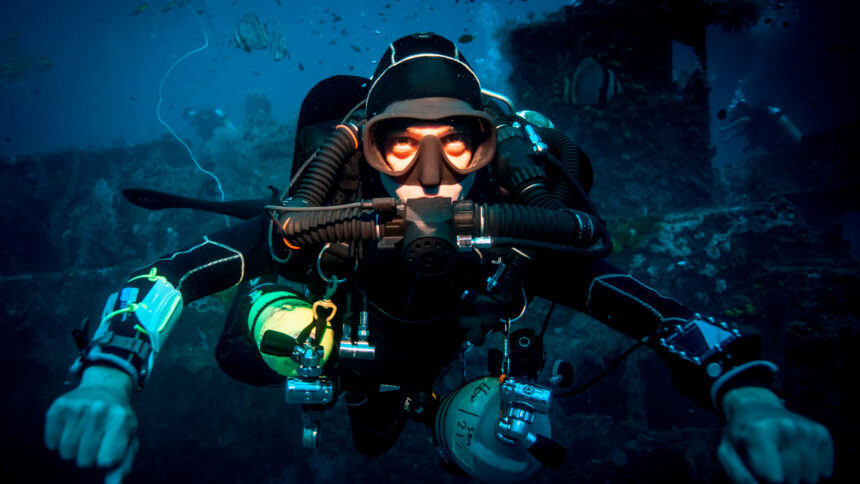
Have you ever wondered how technical divers explore underwater caves for hours, or how military divers complete covert operations in complete silence? The answer lies in revolutionary breathing technology that’s transforming the diving world: rebreathers.
- Quick Answer: What Is a Rebreather?
- Table of Contents
- What Is a Rebreather and How Does It Work?
- Types of Rebreathers: CCR vs SCR vs Oxygen Rebreathers
- Benefits of Rebreather Diving
- Rebreather Certification and Training Requirements
- Cost Analysis: Investment and Maintenance
- Safety Considerations and Risk Management
- Best Rebreathers for Different Diving Levels (2026)
- Rebreather vs Traditional Scuba: Which Is Right for You?
- Comparison Table: Rebreather vs Open-Circuit Scuba
- FAQ: Your Rebreather Questions Answered
- Conclusion: Is Rebreather Diving Right for Your Future?
Unlike traditional scuba equipment that releases bubbles with every breath, rebreathers recycle your exhaled air, removing carbon dioxide and adding oxygen back into the breathing loop. This isn’t just futuristic diving technology—it’s a proven system that’s becoming increasingly accessible to recreational divers in 2026. Whether you’re a curious beginner dreaming of extended dive times, an intermediate diver ready to advance your skills, or a technical diver planning deep expeditions, understanding rebreathers opens entirely new underwater possibilities.
In this comprehensive guide, you’ll discover everything about rebreather diving: how these systems work, the different types available, certification requirements, costs, safety considerations, and whether a rebreather is the right choice for your diving goals. By the end, you’ll have expert-level knowledge to make informed decisions about this game-changing dive technology.
Quick Answer: What Is a Rebreather?
A rebreather is a breathing apparatus that recycles exhaled air by removing carbon dioxide and replenishing oxygen, allowing divers to breathe the same gas multiple times. Here’s what you need to know:
- Extended dive times: 3-6 hours on a single fill versus 45-60 minutes with traditional scuba
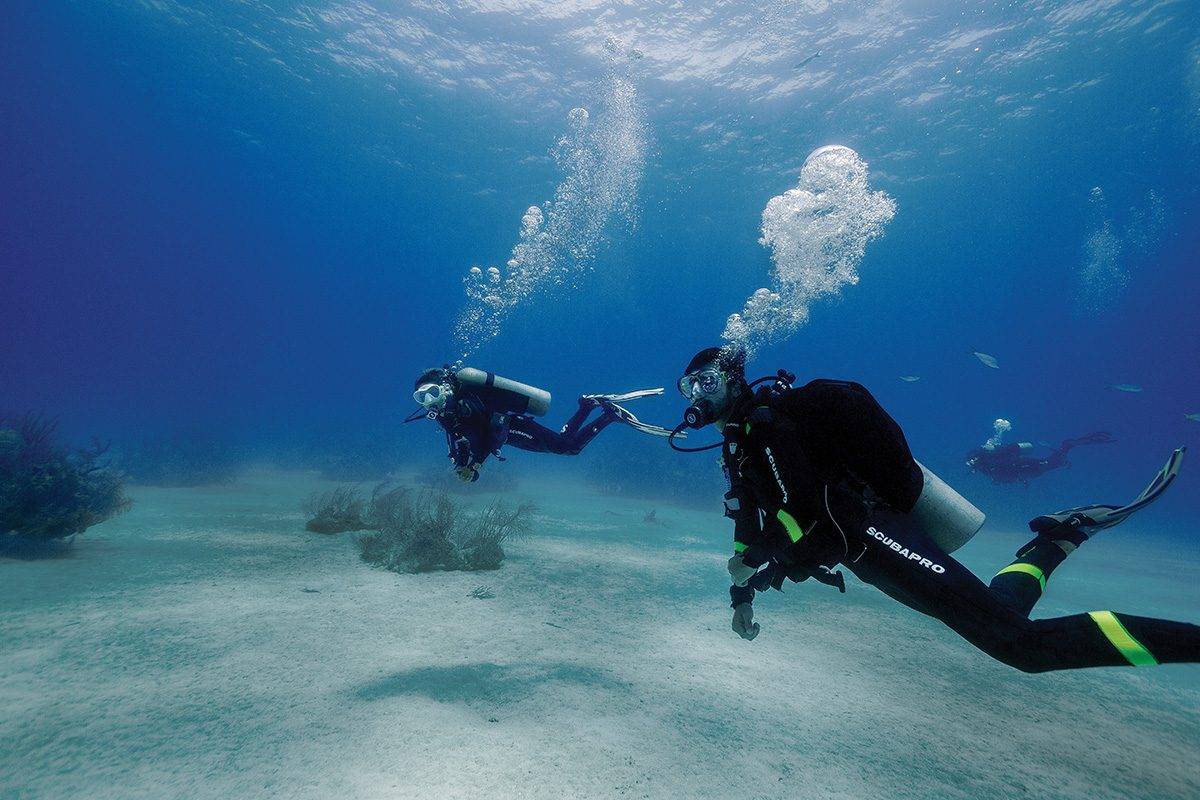
- No bubbles: Creates silent diving, ideal for marine life photography and observation
- Two main types: Closed-Circuit Rebreathers (CCR) and Semi-Closed Rebreathers (SCR)
- Higher cost: Initial investment ranges from $3,500-$15,000+ depending on the system
- Specialized training required: Certification courses typically take 5-7 days
- Better gas efficiency: Uses 90-95% less gas than traditional open-circuit scuba systems
Table of Contents
- What Is a Rebreather and How Does It Work?
- Types of Rebreathers: CCR vs SCR vs Oxygen Rebreathers
- Benefits of Rebreather Diving
- Rebreather Certification and Training Requirements
- Cost Analysis: Investment and Maintenance
- Safety Considerations and Risk Management
- Best Rebreathers for Different Diving Levels (2026)
- Rebreather vs Traditional Scuba: Which Is Right for You?
- FAQ: Your Rebreather Questions Answered
What Is a Rebreather and How Does It Work?
A rebreather represents a fundamental shift from traditional open-circuit scuba systems. Instead of wasting 95% of the oxygen in each exhaled breath by releasing it into the water as bubbles, rebreathers capture, clean, and recycle that air through a sophisticated closed-loop system.
The Basic Rebreather Cycle:
The breathing process in a rebreather follows four essential steps that happen continuously during your dive. First, you inhale oxygen-enriched gas from the breathing loop. Second, you exhale into the same loop, but instead of releasing bubbles, the exhaled gas travels through a carbon dioxide scrubber—typically containing a chemical called soda lime or sofnolime. Third, the scrubber removes CO2 from your exhaled breath through a chemical reaction. Fourth, oxygen sensors monitor the gas mixture, and the system automatically or manually adds pure oxygen to replace what you metabolized.
This closed-circuit process creates a remarkably efficient system. According to research published by the Divers Alert Network in 2025, rebreathers use only 5-10% of the gas consumed by traditional scuba systems at equivalent depths and dive times.
Key Components of Modern Rebreathers:
Every rebreather system, regardless of manufacturer, contains several critical components. The breathing loop consists of two corrugated hoses—an inhalation hose and an exhalation hose—that create the circular path for your breathing gas. The scrubber canister holds the CO2-absorbing material and typically lasts 2-4 hours depending on water temperature, dive depth, and your breathing rate.
Oxygen sensors constantly monitor the partial pressure of oxygen (PPO2) in your breathing loop, ensuring it stays within safe limits between 0.7 and 1.4 bar. The oxygen addition system—either manual or automatic—injects pure oxygen to maintain optimal gas mixture. Diluent gas, usually air or trimix, is used to balance the breathing loop and prevent oxygen toxicity at depth.
Modern rebreathers also include sophisticated electronics with heads-up displays showing real-time information: current PPO2 levels, decompression status, dive time, depth, and system warnings. As of 2026, most advanced units feature AI-assisted monitoring that predicts scrubber exhaustion and alerts divers before critical situations develop.
The Chemical Magic: CO2 Scrubbing:
The heart of any rebreather is its CO2 removal system. When you exhale, your breath contains approximately 4-5% carbon dioxide—a toxic gas that must be eliminated before you can safely breathe that air again. The chemical scrubber contains calcium hydroxide (soda lime), which reacts with CO2 to form calcium carbonate, water, and heat.
This exothermic reaction actually warms your breathing gas, making rebreather diving noticeably warmer and more comfortable than traditional scuba, especially in cold water environments. A single scrubber canister can process 100-200 liters of gas before requiring replacement, though conservative dive planning typically limits use to 2-3 hours maximum.
Types of Rebreathers: CCR vs SCR vs Oxygen Rebreathers
Understanding the three primary rebreather categories helps you identify which system best matches your diving goals and experience level.
Closed-Circuit Rebreathers (CCR)
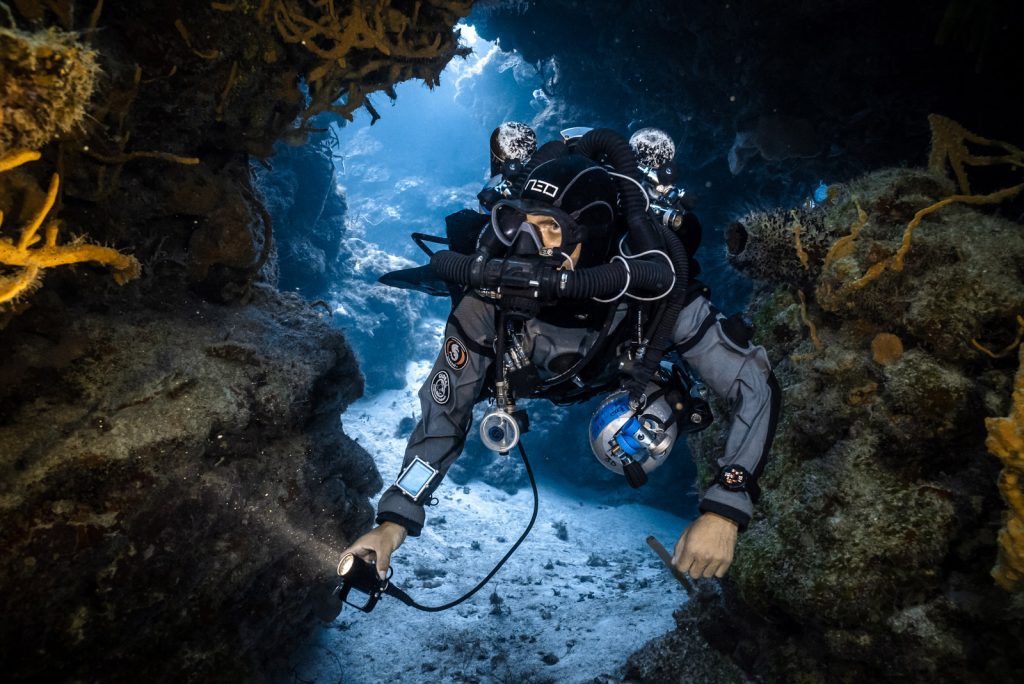
Closed-Circuit Rebreathers represent the most sophisticated and popular rebreather technology in 2026. These systems maintain a constant partial pressure of oxygen regardless of depth, making them exceptionally efficient and versatile.
How CCRs Work:
CCRs continuously monitor oxygen levels through multiple sensors (typically three for redundancy) and automatically inject pure oxygen to maintain your preset PPO2 setpoint, usually between 1.2 and 1.3 bar. When you descend, the system adds diluent gas to prevent oxygen toxicity. When you ascend, excess gas vents from the loop automatically.
The sophistication of modern CCRs is remarkable. Units like the Shearwater Peregrine TX and AP Diving Inspiration use advanced algorithms that calculate optimal gas mixtures in real-time, adjust for temperature changes, and provide comprehensive decompression information based on actual tissue loading rather than theoretical profiles.
CCR Advantages:
According to data from DAN Europe’s 2025 rebreather study, CCR divers report 40-60% longer dive times compared to open-circuit diving at similar depths. The constant PPO2 means optimal decompression efficiency—your body off-gasses nitrogen more effectively because you’re always breathing the ideal oxygen concentration. This translates to shorter decompression obligations or the ability to dive deeper and longer within no-decompression limits.
Best For: Technical divers, underwater photographers, research divers, and experienced recreational divers seeking extended bottom times and access to advanced dive sites.
Semi-Closed Rebreathers (SCR)
Semi-Closed Rebreathers offer a middle ground between traditional scuba and full CCRs. These systems recycle most exhaled gas but continuously vent a small portion of bubbles to maintain safe oxygen levels.
The SCR Approach:
Instead of oxygen sensors and electronic control systems, SCRs use a passive orifice that releases a predetermined amount of gas on each breath. Fresh oxygen-enriched gas (typically 32-40% oxygen nitrox) flows continuously into the breathing loop at a fixed rate, while excess gas vents through a one-way valve.
This mechanical simplicity makes SCRs more affordable ($3,500-$7,000) and easier to maintain than CCRs. However, they’re less efficient—using about 25-30% of the gas consumed by open-circuit scuba versus CCRs’ 5-10%—and depth-limited because the oxygen percentage remains constant as pressure changes.
SCR Limitations:
The Dolphin SCR and Draeger Dolphin systems popular in Europe have maximum operating depths around 100-120 feet (30-40 meters) due to oxygen toxicity concerns. Below these depths, the oxygen percentage becomes dangerously high. Additionally, SCRs still produce small bubble streams, eliminating some of the stealth advantages of rebreather diving.
Best For: Recreational divers wanting extended dive times without the complexity and cost of CCRs, and divers primarily operating in shallower environments like coral reefs and wreck sites.
Oxygen Rebreathers
Oxygen rebreathers are the simplest rebreather design, using 100% oxygen in a closed loop. They’re strictly limited to shallow depths—maximum 20 feet (6 meters)—because breathing pure oxygen below this depth causes oxygen toxicity.
Specialized Applications:
Military and commercial divers use oxygen rebreathers for shallow-water operations requiring complete silence and minimal thermal signature. In recreational diving, they’re rare but occasionally used for extended shallow reef surveys, underwater pool training, or scientific work in very shallow environments.
The U.S. Navy’s LAR-V oxygen rebreather remains the gold standard for military applications, offering 4-6 hour dive times at depths under 20 feet with zero bubble signature.
Best For: Military divers, shallow scientific surveys, and specialized commercial applications. Not recommended for recreational sport diving due to severe depth limitations.
Benefits of Rebreather Diving
Understanding why divers invest thousands of dollars and hundreds of training hours into rebreather systems reveals the transformative advantages these technologies offer.
Extended Bottom Time
The most immediate benefit is dramatically longer underwater time. While a standard aluminum 80 cubic foot tank provides 45-60 minutes at 60 feet on open-circuit scuba, a CCR diver at the same depth can easily achieve 3-4 hours on the same gas volume.
This efficiency comes from recycling oxygen. Your body only metabolizes about 5% of the oxygen you inhale—traditional scuba wastes the remaining 95% with each exhaled bubble. Rebreathers capture and reuse that oxygen, making every breath count.
Underwater photographer David Doubilet noted in a 2025 National Geographic interview: “Rebreathers changed everything for my work. Instead of 45-minute dives constantly checking my air supply, I now spend 3-4 hours observing marine behavior without interruption. You become part of the reef environment rather than a temporary visitor.”
Silent Diving and Marine Life Interaction
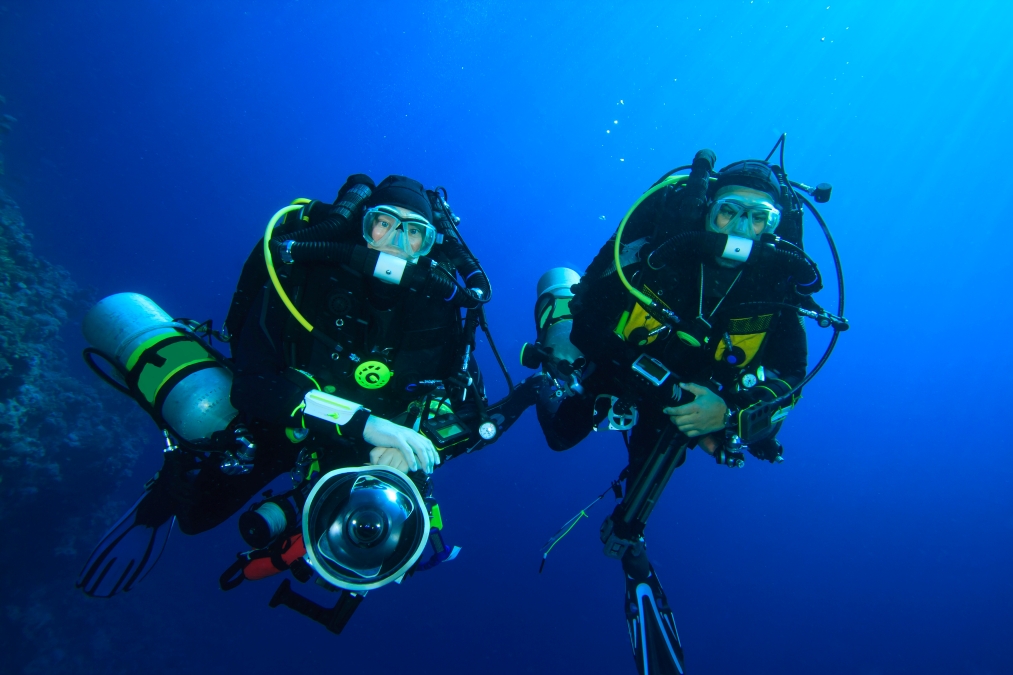
The absence of bubbles creates a fundamentally different diving experience. Research from the Marine Biological Laboratory (2024) demonstrated that fish approach rebreather divers 60-70% closer than open-circuit divers, and exhibit natural behaviors rather than avoidance patterns.
For underwater videographers and wildlife photographers, this advantage is invaluable. Shy species like seahorses, frogfish, and octopuses tolerate prolonged observation from rebreather divers. Larger animals—sharks, manta rays, whales—show curiosity rather than caution when encountering silent divers.
Beyond photography, the quiet environment is meditative. Many rebreather divers describe a zen-like quality to their dives, hearing only the subtle sounds of the reef ecosystem and their own breathing cycle.
Optimal Gas Mixture at Every Depth
CCR systems continuously adjust your breathing gas to maintain ideal oxygen levels. This has profound physiological benefits.
At depth, too much oxygen causes toxicity; too little causes hypoxia. Open-circuit divers breathe fixed-mixture gases that compromise between these dangers. CCRs automatically optimize your gas mixture—higher oxygen during shallow decompression stops to accelerate nitrogen off-gassing, lower oxygen at maximum depth to prevent toxicity.
According to research published in Diving and Hyperbaric Medicine (2025), CCR divers experience 25-30% reduction in decompression time compared to open-circuit divers making identical depth-time profiles, simply because they breathe optimal gas mixtures throughout their dive.
Reduced Decompression Obligation
The constant optimal PPO2 means more efficient nitrogen elimination from your tissues. This translates to either shorter required decompression stops or increased no-decompression limits at any given depth.
Technical diver and instructor Jill Heinerth explains: “On a 200-foot wreck penetration that requires 90 minutes of decompression on open-circuit trimix, I complete the same dive with 60-65 minutes of decompression on my CCR. That’s significant when you’re hanging on a line in current.”
Warmth and Comfort
The exothermic chemical reaction in the CO2 scrubber generates heat, warming your breathing gas. In cold water diving, this makes a noticeable difference in comfort and thermal management.
Canadian ice divers report breathing gas temperatures 15-20°F warmer on rebreathers compared to open-circuit systems, significantly extending comfortable dive times in sub-40°F water.
Gas Cost Savings (Long-Term)
While rebreathers require substantial upfront investment, operational costs are dramatically lower. A technical dive requiring $150-200 in helium-based trimix on open-circuit might cost $30-50 on a CCR.
Divers making 100+ dives annually often recover their rebreather investment within 2-3 years through gas savings alone. For professional divers, underwater researchers, and dive instructors, the economic case is compelling.
Rebreather Certification and Training Requirements
Rebreather diving demands specialized knowledge and skills beyond recreational scuba certification. The training investment is substantial but essential for safety.
Prerequisites for Rebreather Training
Most rebreather courses require:
- Advanced Open Water Diver certification (or equivalent)
- Minimum 30-50 logged dives
- Excellent buoyancy control and fundamental diving skills
- Age 18 or older
- Current diving medical clearance
Some technical rebreather programs additionally require:
- Nitrox certification
- Deep diver specialty (for units rated beyond 130 feet)
- Rescue diver certification
These prerequisites aren’t arbitrary. Rebreather diving adds complexity and task loading. You must maintain perfect buoyancy while monitoring multiple displays, conducting pre-breathe checks, and managing the breathing loop.
Certification Levels and Progression
Entry-Level Rebreather Diver (Recreational CCR):
Training organizations like TDI, PADI, and IANTD offer recreational rebreather courses typically lasting 4-6 days. Coursework includes:
- Unit-specific assembly, disassembly, and pre-dive checks (2-3 hours of procedures)
- Oxygen sensor calibration and monitoring
- CO2 scrubber packing and duration calculations
- Emergency procedures: bailout to open-circuit, hypoxia and hyperoxia recognition
- Confined water skills practice (4-6 hours)
- Open water dives (minimum 6-12 dives depending on agency)
Certification limits recreational CCR divers to maximum 100 feet (30 meters) and no-decompression diving. Course costs range from $1,200-2,000 not including rebreather rental.
Advanced/Technical Rebreather:
After gaining 25-50 hours of rebreather experience, divers can pursue advanced certifications allowing:
- Decompression diving on rebreathers
- Depths to 200+ feet depending on certification level
- Trimix diluent use for deep diving
- Cave or wreck penetration on rebreathers
Technical rebreather courses run 7-10 days with 15-20 training dives and cost $2,500-4,000.
Unit-Specific Training
Here’s a critical point many new divers miss: your certification is unit-specific. If you’re certified on an AP Diving Inspiration, you need additional training and certification to dive a different model like the rEvo or Poseidon Se7en.
Different rebreathers have unique:
- Pre-dive checklists and assembly procedures
- Electronic interfaces and alarms
- Scrubber configurations and duration ratings
- Bailout and emergency protocols
Crossover courses typically require 2-3 days of training and cost $500-800, though experienced rebreather divers often complete them faster.
Ongoing Education and Skills Maintenance
The rebreather community emphasizes continuous learning. Recommended practices include:
- Refresher training if you haven’t dived your unit in 6+ months
- Annual skills evaluation with an instructor
- Manufacturer-specific service courses for maintenance
- Participation in rebreather diving forums and workshops
The website ScubaBoard’s Rebreather Forum and Rebreather World provide excellent ongoing education resources, equipment reviews, and community support for rebreather divers worldwide.
Cost Analysis: Investment and Maintenance
Understanding the complete financial picture helps you make informed rebreather purchasing decisions.
Initial Investment Breakdown
Entry-Level Recreational CCRs: $8,000-$12,000
- Poseidon Se7en: $8,500-9,500
- Hollis Prism 2: $9,200-10,500
- Dive Rite O2ptima: $9,800-11,200
These units include basic electronics, single oxygen setpoint, and recreational depth ratings (100-130 feet).
Mid-Range Technical CCRs: $11,000-$15,000
- AP Diving Inspiration: $11,500-13,000
- rEvo III: $12,800-14,200
- JJ-CCR: $13,500-15,000
Advanced features include multiple setpoints, trimix capability, technical depth ratings (200-300 feet), and sophisticated electronics.
High-End Expedition CCRs: $15,000-$20,000+
- Megalodon: $16,500-18,000
- KISS Classic GEM: $15,800-17,200
- Custom-built technical units: $18,000+
These represent ultimate reliability for extreme exploration, cave diving, and extended expeditions with redundant systems and modular configurations.
Semi-Closed Rebreathers: $3,500-$7,000
- Draeger Dolphin: $4,200-5,500
- Inspiration Evolution (SCR mode): $5,800-6,800
Lower cost but limited depth range and reduced efficiency.
Essential Accessories (Budget $2,000-$4,000)
Your rebreather purchase is just the beginning:
- Bailout cylinder(s): $300-600 (aluminum 40 or 80 cf tanks)
- Bailout regulator: $400-700 (reliable second stage essential)
- Mounting hardware and rigging: $200-400
- Backup computers and gauges: $500-1,000
- Spare oxygen sensors (3-set): $200-300
- Scrubber material (annual supply): $300-500
- Transportation case: $300-500
- Training and certification: $1,200-2,000
Annual Maintenance Costs
Rebreathers require regular servicing to maintain safety and performance:
Consumables (per year, 50-100 dives):
- CO2 scrubber material: $600-1,200
- Oxygen sensor replacements (12-18 month lifespan): $200-400
- Breathing loop hose replacement: $150-300 (every 2-3 years)
- Mouthpiece and checkvalves: $50-100
- O-rings and seals: $50-100
- Batteries for electronics: $30-80
Service and Certification:
- Annual factory service: $400-800
- Oxygen sensor validation: $100-200
- Hydrostatic testing (every 5 years): $150-250
Total annual cost: $1,200-$2,500 depending on dive frequency.
Cost Comparison: Rebreather vs Open-Circuit
For technical diving, rebreathers offer genuine savings:
Deep Trimix Dive (200 feet, 30-minute bottom time):
- Open-circuit: $180-250 in helium/trimix fills per dive
- CCR: $30-50 in oxygen and diluent fills per dive
- Savings per dive: $130-200
After 75-100 technical dives, a rebreather pays for itself through gas savings alone. For recreational diving within no-decompression limits, gas savings are less dramatic but still significant over time.
If you’re considering entering technical diving and plan to dive regularly, investing in a rebreather makes strong financial sense. For occasional recreational diving, the cost-benefit equation is less clear-cut.
Safety Considerations and Risk Management
Rebreathers are remarkably safe when properly maintained and operated within training limits. However, they introduce failure modes that don’t exist in open-circuit scuba.
Primary Rebreather Hazards
Hypoxia (Insufficient Oxygen):
This occurs when oxygen levels drop below 0.16 bar partial pressure, causing unconsciousness without warning symptoms. Causes include:
- Oxygen addition system failure
- Depleted oxygen cylinder
- Failed oxygen sensors giving false readings
- Manual addition valve left closed
Prevention requires vigilant monitoring of PPO2 displays, regular sensor calibration, and thorough pre-dive checklists.
Hyperoxia (Oxygen Toxicity):
Excessive oxygen (PPO2 above 1.6 bar) can cause seizures underwater, almost always fatal. Contributing factors:
- Solenoid stuck open flooding loop with oxygen
- Incorrect setpoint programming
- Diving deeper than planned on high setpoints
- Ascending too fast with manually-added oxygen
Modern CCRs include high PPO2 alarms and automatic diluent addition to prevent toxicity, but disciplined diving practices remain essential.
Hypercapnia (CO2 Buildup):
Exhausted scrubber material or scrubber flooding allows carbon dioxide to accumulate in the breathing loop. Symptoms progress from headache and increased breathing rate to confusion, panic, and loss of consciousness.
A 2024 study by the Rebreather Education and Safety Association found scrubber-related incidents decreased 70% between 2020-2024 due to improved canister duration monitoring and conservative dive planning.
Critical Safety Protocols
Pre-Dive Checklists:
Every rebreather dive must begin with comprehensive pre-dive procedures:
- Oxygen sensor calibration (in air, then 100% oxygen)
- Positive and negative pressure tests (loop integrity verification)
- Pre-breathe (5 minutes minimum to verify scrubber function and oxygen addition)
- Electronic systems check (displays, alarms, battery levels)
- Bailout gas verification (pressure, mixture, regulator function)
- Buddy verification of all procedures
Rushing these procedures causes accidents. Plan 30-45 minutes for rebreather pre-dive setup versus 10 minutes for open-circuit scuba.
Bailout Planning:
You must carry sufficient open-circuit gas to reach the surface from your maximum planned depth, including all required decompression stops. This typically means:
- Recreational dives (100 feet): Minimum 40 cf bailout cylinder
- Technical dives (200 feet): 80-120 cf bailout with appropriate gas mixture
- Cave/overhead dives: Multiple bailout cylinders staged throughout the dive
Calculate bailout requirements assuming elevated breathing rate (surface air consumption of 1.0-1.5 cf/minute) to account for stress.
The “Three-Foot Rule”:
Advanced rebreather divers follow a conservative principle: never trust any single display or sensor. Always verify critical information through multiple independent sources:
- Three oxygen sensors (voting logic identifies failures)
- Backup depth gauge and timer
- Independent dive computer monitoring decompression
- Buddy monitoring and communication
Rebreather Diving Fatality Statistics
The sobering truth: rebreather diving has higher fatality rates than open-circuit scuba. According to DAN’s 2025 Annual Diving Report, rebreathers account for approximately 15-20% of recreational diving fatalities despite representing less than 3% of active divers.
However, deeper analysis reveals most incidents involved:
- Inadequate training (diving beyond certification limits)
- Skipped or rushed pre-dive checks
- Solo diving without proper bailout
- Equipment maintenance failures
- Medical conditions exacerbated by rebreather use
When divers follow proper protocols, maintain equipment meticulously, and dive within training limits, rebreather safety approaches or exceeds open-circuit diving safety.
Best Rebreathers for Different Diving Levels (2026)
Selecting the right rebreather depends on your experience, diving goals, and budget.
Best for Beginners: Poseidon Se7en
Price: $8,500-9,500
The Poseidon Se7en earns top marks for simplicity and safety in the recreational rebreather category. Its fully automatic operation removes much of the manual task loading that challenges new rebreather divers.
Key Features:
- Completely automatic oxygen addition (no manual controls)
- Foolproof scrubber canister with built-in duration monitoring
- Integrated buoyancy compensator
- Maximum depth: 130 feet
- Dive duration: 3 hours typical
Why it’s perfect for beginners: The Se7en handles oxygen addition automatically, allowing you to focus on buoyancy, navigation, and enjoying your dive. The simplified pre-dive checklist (compared to manual CCRs) reduces opportunities for critical errors.
Best All-Around CCR: rEvo III
Price: $12,800-14,200
The rEvo III represents exceptional value, combining technical capability with relative affordability. Its modular design allows configuration from recreational to extreme technical diving.
Key Features:
- Dual scrubber canisters (extended duration or redundancy)
- Manual and automatic oxygen addition modes
- Trimix capable to 300+ feet
- Excellent work of breathing at all depths
- Large, active online community providing support
Why divers love it: The rEvo balances sophistication with reliability. It’s forgiving for newer rebreather divers yet capable enough for extreme technical expeditions. Strong resale value makes it smart long-term investment.
Best for Technical Diving: JJ-CCR
Price: $13,500-15,000
Jan Jansen’s JJ-CCR design has earned legendary status in technical diving circles for bulletproof reliability and exceptional work of breathing.
Key Features:
- Radial scrubber design (industry-leading CO2 removal efficiency)
- Modular construction (easy travel and maintenance)
- Outstanding performance in cold water
- Depth rating: unlimited (dived to 600+ feet)
- Optional sidemount configuration
Technical diver’s choice: Cave divers, deep wreck penetration specialists, and polar explorers consistently choose JJ-CCRs. The radial scrubber provides 4-5 hour duration even in 40°F water, and the modular design allows field repairs other units can’t match.
Best Budget Option: Dive Rite O2ptima
Price: $9,800-11,200
For divers seeking CCR advantages without premium pricing, the O2ptima delivers solid performance and reliability.
Key Features:
- Chestmount configuration (excellent streamlining)
- Manual oxygen addition (active diver engagement)
- Depth rating: 300 feet
- Simple mechanical design (fewer potential failure points)
- Strong manufacturer support and training network
Value proposition: The O2ptima requires more active management than automatic units, but many technical divers consider this an advantage—you maintain constant awareness of loop status. Lower initial cost accelerates return on investment for gas savings.
Best for Photographers: AP Diving Inspiration
Price: $11,500-13,000
Underwater photographers worldwide choose the Inspiration for its stability, quiet operation, and comfortable extended-duration performance.
Key Features:
- Backmount configuration (frees up chest for cameras)
- Exceptionally stable loop volume (minimal buoyancy shifts)
- Vision heads-up display (monitoring without checking wrist)
- Depth rating: 200 feet recreational, 300+ with technical certification
- 15+ year proven track record
Why photographers prefer it: The stable buoyancy characteristics mean you can achieve neutral buoyancy and essentially forget about the rebreather while focusing on your photography. The backmount design keeps your chest and hands free for large camera rigs.
Rebreather vs Traditional Scuba: Which Is Right for You?
The decision to transition from open-circuit scuba to rebreathers is highly personal. Consider these factors:
Choose Rebreather If You:
- Dive frequently (50+ times annually) and costs add up
- Focus on underwater photography or videography
- Pursue technical diving (caves, deep wrecks, mixed gas)
- Value extended bottom time for research or observation
- Dive in remote locations where gas fills are expensive or unavailable
- Enjoy mechanical systems and meticulous equipment maintenance
- Have strong fundamental diving skills and excellent buoyancy control
- Seek the ultimate diving experience and don’t mind complexity
Stick with Open-Circuit If You:
- Dive occasionally (fewer than 25 dives per year)
- Prefer simple, low-maintenance equipment
- Primarily dive tropical vacation destinations with dive operators
- Enjoy the social aspects of buddy diving and group dive boats
- Have limited budget for equipment and training
- Want maximum equipment reliability with minimal pre-dive procedures
- Dive with operators or destinations that don’t support rebreathers
- Aren’t comfortable with complex emergency procedures
The Hybrid Approach
Many experienced divers maintain both open-circuit and rebreather systems, choosing equipment based on specific dive objectives:
- Casual reef diving on vacation: Open-circuit
- Local photography dives: Rebreather
- Deep wreck penetration: Rebreather with extensive bailout
- Teaching or guiding others: Open-circuit for simplicity
This flexibility maximizes your diving opportunities while matching equipment to circumstances.
Comparison Table: Rebreather vs Open-Circuit Scuba
| Feature | Rebreather (CCR) | Open-Circuit Scuba |
|---|---|---|
| Initial Cost | $8,000-$20,000+ | $1,500-$3,000 |
| Dive Duration | 3-6 hours typical | 45-90 minutes |
| Gas Efficiency | Uses 5-10% of OC consumption | Standard baseline |
| Bubbles | Silent (zero bubbles) | Continuous bubbles |
| Training Required | 4-10 days specialized | 3-4 days basic certification |
| Pre-Dive Time | 30-45 minutes | 5-10 minutes |
| Maintenance | High (weekly cleaning, annual service) | Low (annual service) |
| Annual Operating Cost | $1,200-$2,500 | $300-$800 |
| Depth Capability | 300+ feet (with training) | 130 feet recreational standard |
| Best For | Technical diving, photography, research | Recreational diving, travel, beginners |
FAQ: Your Rebreather Questions Answered
Q: How dangerous are rebreathers compared to regular scuba diving?
A: When properly maintained and operated within training limits, rebreathers are very safe. However, statistics show higher incident rates because rebreathers introduce additional failure modes like oxygen sensor failures and CO2 buildup. The key difference is that open-circuit scuba has simple, obvious failures (you run out of air), while rebreather failures can be subtle and require immediate recognition. Comprehensive training and disciplined procedures make rebreather diving as safe as any technical diving activity.
Q: How long does a rebreather scrubber last?
A: Scrubber duration depends on water temperature, depth, and your breathing rate. In tropical water (80°F+), expect 3-4 hours. In cold water (below 50°F), duration decreases to 2-3 hours. Modern units include duration monitoring systems, but conservative practice dictates planning for shorter duration than manufacturer specifications and never exceeding 3 hours regardless of indicators.
Q: Can you fly after rebreather diving?
A: Yes, the same surface interval guidelines apply: minimum 12 hours for no-decompression dives, 18-24 hours after decompression dives. Because rebreathers optimize oxygen levels throughout your dive, you may actually off-gas nitrogen more efficiently than open-circuit diving, though conservative practices still recommend standard surface intervals before flying.
Q: Do rebreathers work in cold water?
A: Absolutely. In fact, rebreathers excel in cold water because the scrubber reaction warms your breathing gas. However, cold water requires special considerations: shorter scrubber duration ratings, flood recovery procedures, and careful insulation of loop hoses. Many Arctic and Antarctic research divers prefer rebreathers specifically for cold water advantages.
Q: How often do oxygen sensors need replacement?
A: Oxygen sensors typically last 12-18 months but must be validated before every dive through calibration procedures. Many divers replace sensors annually as preventative maintenance, while others test sensor response and replace individually as they degrade. Never dive with sensors older than 24 months regardless of apparent function.
Q: What happens if your rebreather fails underwater?
A: This is why bailout gas is mandatory. At the first sign of any malfunction—high or low oxygen warnings, scrubber problems, flooding, or electronic failures—you immediately switch to your bailout regulator and begin a controlled ascent following your pre-planned bailout schedule. This is extensively practiced during training until it becomes automatic.
Q: Can beginners learn rebreather diving, or do you need to be advanced?
A: While rebreather courses require Advanced Open Water certification and 30-50 logged dives, you don’t need to be an elite technical diver. You do need excellent buoyancy control, strong fundamental skills, and the maturity to follow detailed procedures consistently. If you can maintain neutral buoyancy while performing tasks and you’re comfortable with equipment complexity, you can successfully learn rebreather diving.
Q: Are rebreathers allowed on dive boats and resorts?
A: Increasingly yes, though policies vary. Many dive operators in technical diving destinations (Florida caves, Great Lakes wrecks, Pacific deep sites) fully support rebreathers. Tropical resorts are becoming more accepting as rebreathers become mainstream. Always contact operators in advance to confirm their rebreather policies and whether they provide specialized support like oxygen fills and scrubber materials.
Q: How much does rebreather training cost?
A: Entry-level recreational CCR certification typically costs $1,200-2,000 not including rebreather rental (add $500-800 if needed). Technical rebreather courses run $2,500-4,000. Unit-specific crossover courses cost $500-800. Budget additional expenses for scrubber materials during training, gas fills, and potential equipment purchases.
Q: What’s the difference between eCCR and mCCR rebreathers?
A: eCCR (electronic Closed-Circuit Rebreather) uses electronic sensors and solenoids to automatically maintain oxygen levels. mCCR (manual Closed-Circuit Rebreather) requires you to manually inject oxygen based on depth changes and time. Most modern recreational rebreathers are eCCRs because they reduce task loading, while some technical divers prefer mCCRs for their simplicity and lack of battery dependence.
Q: Can you share air from a rebreather like you can with regular scuba?
A: No, you cannot donate your breathing loop to another diver—it’s contaminated with CO2 and may have improper oxygen levels for their depth. This is why bailout gas is mandatory. In an emergency, you donate your bailout regulator while switching to a secondary bailout source or making a controlled emergency ascent. Buddy procedures on rebreather dives require both divers carry adequate independent bailout.
Q: How do you travel with a rebreather?
A: Rebreathers require careful travel planning. Most modern units disassemble into airline-checkable cases. Remove oxygen sensors and batteries for carry-on (lithium batteries aren’t allowed in checked luggage). Ship scrubber material ahead or purchase at destination since airlines prohibit calcium hydroxide. Many rebreather divers use specialized travel cases and declare their equipment to airlines in advance to avoid complications.
Q: Do rebreathers require more physical fitness than regular scuba?
A: Not necessarily. Work of breathing on modern rebreathers is comparable to or better than traditional scuba. However, the added equipment weight (30-45 pounds complete) requires good physical condition for surface handling. Underwater, rebreathers are well-balanced and neutrally buoyant. The mental demands—monitoring displays, following procedures—are higher than open-circuit diving.
Q: What maintenance does a rebreather need after each dive?
A: Post-dive maintenance is essential and takes 30-60 minutes: thoroughly rinse all components with fresh water, disassemble and clean breathing loop, remove and dispose of used scrubber, dry all interior surfaces completely, inspect O-rings and seals, clean and sanitize mouthpiece, charge batteries, and document dive details and any issues. Weekly or monthly, perform deeper cleaning and inspection of all components.
Q: Are there rebreathers specifically designed for women or smaller divers?
A: While most rebreathers aren’t gender-specific, some models work better for smaller frames. Chestmount units like the O2ptima and sidemount configurations can be more comfortable for smaller divers than large backmount units. Harness systems are fully adjustable, and modern designs accommodate divers from 5’0″ to 6’4″+ without issues. Work with experienced instructors to find optimal fit and configuration.
Conclusion: Is Rebreather Diving Right for Your Future?
Rebreather technology has transformed from exotic military equipment to accessible mainstream diving systems in less than three decades. As of 2026, these sophisticated breathing apparatuses offer unprecedented capabilities—3-6 hour dive times, silent marine life observation, optimal gas mixtures at every depth, and access to dive sites impossible on open-circuit scuba.
The three key takeaways for aspiring rebreather divers:
First, understand that rebreathers demand commitment—financial investment of $8,000-$20,000 plus ongoing maintenance costs, training investment of 4-10 days for certification, and time investment of 30-45 minutes pre-dive procedures for every dive. This isn’t casual equipment.
Second, recognize that rebreather diving requires discipline and attention to detail. Skipped procedures, rushed checklists, or inadequate maintenance can have serious consequences. If you thrive with systematic approaches and enjoy understanding complex mechanical systems, rebreathers will suit your personality.
Third, the rewards justify the requirements for committed divers. Extended bottom times transform your underwater experiences from brief visits to immersive observations. Silent diving creates magical interactions with marine life impossible otherwise. For technical divers, rebreathers unlock caves, deep wrecks, and extreme depths that open-circuit simply cannot reach economically or practically.
Your next steps toward rebreather diving:
- Connect with the rebreather community through forums like ScubaBoard and Rebreather World to learn from experienced divers
- Try before you buy by taking a discovery or try-dive program at a rebreather-friendly dive center
- Research specific models that match your diving goals and budget using the recommendations in this guide
- Locate qualified instructors in your area who teach the rebreather models you’re considering
- Invest in quality training from experienced instructors rather than seeking the cheapest certification
The underwater world awaits exploration with technology that would have seemed like science fiction just decades ago. Whether you’re a photographer seeking that perfect shot, a technical diver planning deep expeditions, or simply a diving enthusiast ready for the next level, rebreathers open extraordinary possibilities.
Ready to explore rebreather options? Visit Dive Gear for comprehensive rebreather packages, expert consultations, and ongoing support as you begin your rebreather journey.
The silent revolution in diving technology is here. The only question is: are you ready to join it?