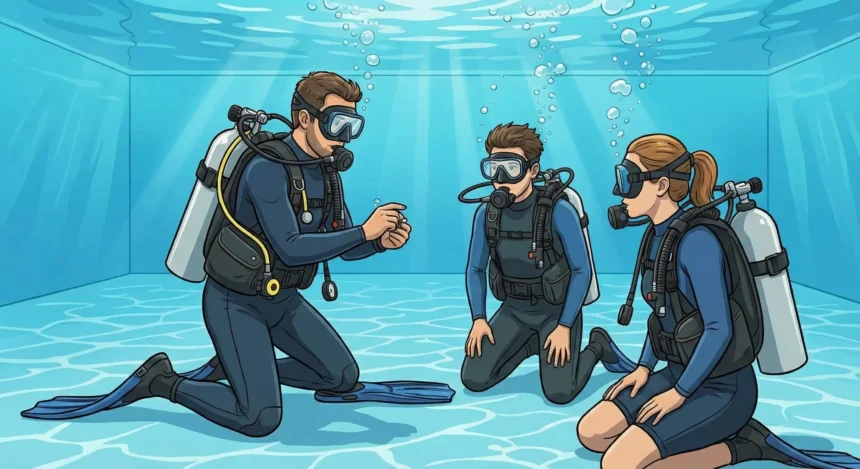
Have you ever wondered what it actually takes to learn how to scuba dive?
- Table of Contents
- What Is Scuba Diving?
- How Does Scuba Diving Work?
- Can Anyone Learn to Scuba Dive?
- Do You Need to Know How to Swim?
- How to Start Scuba Diving
- Step 2: Choose a Qualified Dive School
- Step 3: Complete the Theory
- Step 4: Learn Scuba Skills in Confined Water
- Step 5: Complete Your Open-Water Dives
- Step 6: Become a Certified Diver
- What Equipment Do You Need for Scuba Diving?
- Scuba Diving Equipment Explained
- How Deep Can a Beginner Scuba Diver Go?
- How Long Does a Scuba Dive Last?
- What Happens During Your First Scuba Dive?
- How Much Does Scuba Diving Cost?
- Is Scuba Diving Dangerous?
- Essential Scuba Diving Safety Rules
- How to Equalize Your Ears
- What Is a Buddy System?
- What Is a Dive Computer?
- What Should You Do If You Panic Underwater?
- Can You Scuba Dive Without Certification?
- Scuba Diving vs Snorkeling
- Scuba Diving Mistakes Beginners Should Avoid
- Flying After Scuba Diving
- How to Choose Your First Dive Destination
- What Should You Buy Before Your First Course?
- Beginner Scuba Diving Checklist
- Frequently Asked Questions
- Is scuba diving difficult for beginners?
- How long does it take to learn scuba diving?
- What is the first scuba certification?
- How deep can an Open Water diver go?
- Can non-swimmers scuba dive?
- Do I need to buy scuba equipment?
- Is scuba diving safe?
- Can I scuba dive without certification?
- How long can you stay underwater?
- How long should I wait before flying after scuba diving?
- What should I do if my ears hurt while descending?
- Final Thoughts
For someone who has never been underwater with a tank, scuba diving can seem complicated. There is equipment to understand, certification to choose, skills to learn, underwater communication, pressure changes, dive planning and safety procedures.
The good news is that you do not have to figure everything out at once.
Learning to scuba dive is a step-by-step process. You start by understanding the basics, learn essential skills with a qualified instructor, practice in controlled water, and then progress to open-water diving when you are ready.
This complete guide explains how to scuba dive for beginners, including what scuba diving is, how certification works, what equipment you need, what happens during your first dive, how deep beginners normally dive, how much scuba diving can cost, important safety rules and what you should know before booking your first course.
Quick answer: To learn scuba diving, beginners normally start with an introductory experience or an entry-level certification course such as Open Water Diver. Training combines knowledge development, confined-water skills and open-water dives. The exact requirements, depth limits, medical requirements and course structure depend on the certification agency, instructor and local regulations.
Table of Contents
- What Is Scuba Diving?
- How Does Scuba Diving Work?
- Can Anyone Learn to Scuba Dive?
- Do You Need to Know How to Swim?
- How to Start Scuba Diving
- Step 1: Choose Between a Try Dive and Certification
- Step 2: Choose a Qualified Dive School
- Step 3: Complete the Theory
- Step 4: Learn Scuba Skills in Confined Water
- Step 5: Complete Your Open-Water Dives
- Step 6: Become a Certified Diver
- What Equipment Do You Need for Scuba Diving?
- Scuba Diving Equipment Explained
- How Deep Can a Beginner Scuba Diver Go?
- How Long Does a Scuba Dive Last?
- What Happens During Your First Scuba Dive?
- How Much Does Scuba Diving Cost?
- Is Scuba Diving Dangerous?
- Essential Scuba Diving Safety Rules
- How to Equalize Your Ears
- Why You Should Never Hold Your Breath
- What Is a Buddy System?
- What Is a Dive Computer?
- What Should You Do If You Panic Underwater?
- Can You Scuba Dive Without Certification?
- Scuba Diving vs Snorkeling
- Scuba Diving Mistakes Beginners Should Avoid
- Flying After Scuba Diving
- How to Choose Your First Dive Destination
- What Should You Buy Before Your First Course?
- Beginner Scuba Diving Checklist
- Frequently Asked Questions
- Final Thoughts
What Is Scuba Diving?
SCUBA stands for Self-Contained Underwater Breathing Apparatus.
Unlike snorkeling, where you normally breathe through a tube while remaining at the surface, scuba diving allows a diver to breathe underwater using a tank and regulator.
The regulator reduces the high pressure of gas stored inside the scuba cylinder so that the diver can breathe it at the surrounding water pressure.
A typical recreational scuba setup includes:
- Scuba cylinder
- Regulator
- Buoyancy control device (BCD)
- Mask
- Fins
- Exposure protection such as a wetsuit
- Weight system
- Dive computer or other instruments
The equipment works together to help you breathe, control buoyancy, monitor your dive and move efficiently underwater.
But equipment alone does not make someone a safe diver.
Training, good judgement, appropriate equipment and responsible dive planning are equally important.
How Does Scuba Diving Work?
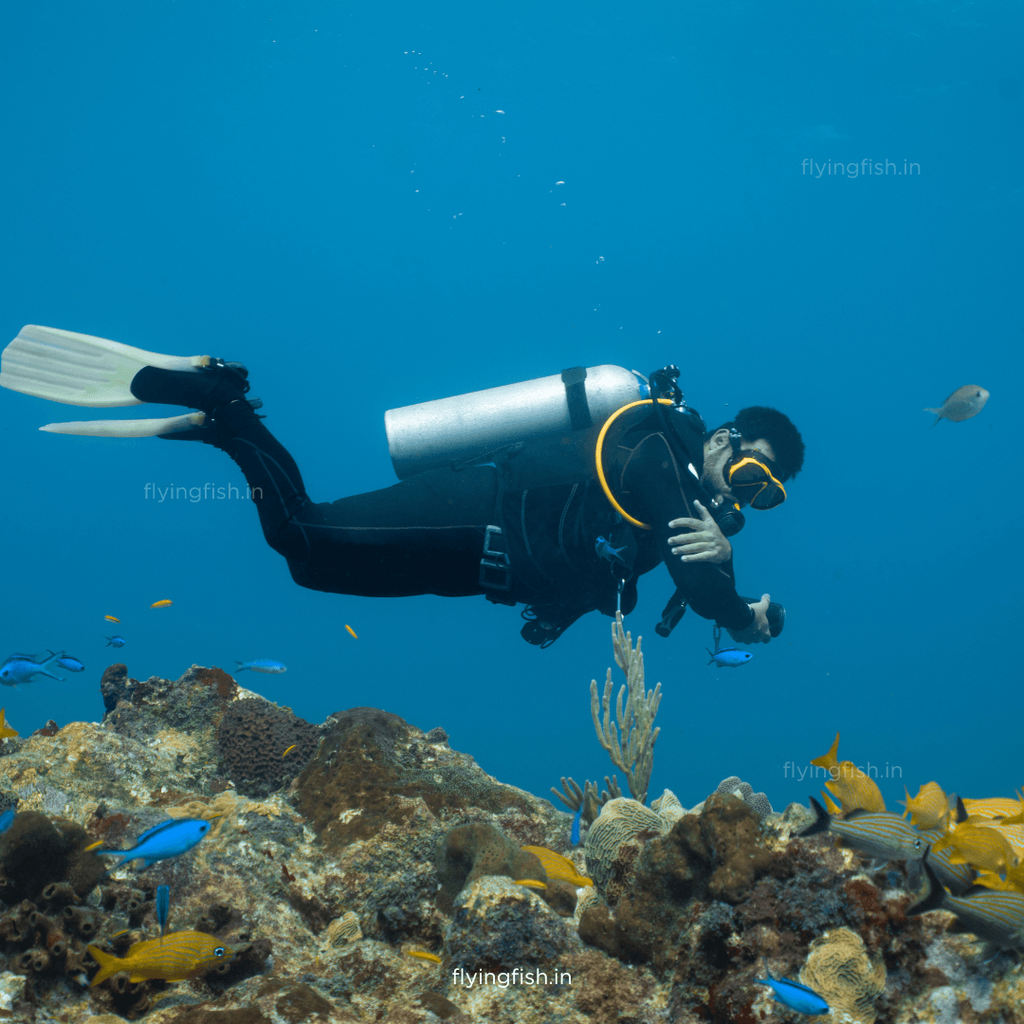
As you descend underwater, surrounding pressure increases.
This affects the air spaces in your body and the gas you breathe.
That is why divers learn skills such as:
- Equalizing the ears
- Controlling buoyancy
- Monitoring air supply
- Managing ascent speed
- Using underwater hand signals
- Responding to equipment or environmental problems
The objective is not simply to go underwater.
A trained diver learns how to remain calm, monitor their surroundings, manage their equipment and follow an appropriate dive plan.
This is one reason formal scuba training is so important.
Can Anyone Learn to Scuba Dive?
Many people can learn scuba diving, but there is no universal “everyone can dive” rule.
Your eligibility can depend on factors such as:
- Age
- Swimming or water comfort
- Medical history
- Current health
- Local requirements
- Certification-agency requirements
- The type of diving you want to perform
Some medical conditions may require additional evaluation before diving.
If you have a medical concern, do not rely on an internet article to decide whether diving is appropriate for you. Discuss it with a qualified diving medical professional or your certification provider.
Do You Need to Know How to Swim?
You do not necessarily need to be an excellent swimmer to experience scuba diving, but water skills are an important part of scuba training.
Certification agencies have specific water-skill requirements for their courses, and these can vary.
For example, PADI’s Open Water Diver training includes swimming and floating assessments as part of the course.
If you are uncomfortable in water, tell the instructor before starting.
Do not hide your swimming ability or water anxiety simply because you want to complete the course quickly.
A good instructor should understand your starting point and explain the requirements clearly.
How to Start Scuba Diving
If you have never scuba dived before, the easiest way to think about the process is:
Learn → Practice → Dive → Review → Progress
Here is what the journey usually looks like.
Step 1: Choose Between a Try Dive and Certification
There are two common starting points.
Option 1: Introductory or Discover Scuba Experience
This is designed for people who want to experience breathing underwater before committing to a full certification course.
You normally receive a briefing, learn basic equipment use and practice underwater with professional supervision.
It can be useful if you are curious but unsure whether scuba diving is for you.
Option 2: Entry-Level Certification
If you already know that you want to become a diver, you can start an entry-level certification course.
The Open Water Diver level is the common starting point across major training systems.
PADI describes its Open Water course as the first certification level and includes knowledge development, confined-water training and open-water dives.
Different agencies have their own course structures, terminology and requirements, so compare the actual course details rather than choosing purely based on the logo.
Step 2: Choose a Qualified Dive School
The instructor and dive centre you choose can have a major effect on your learning experience.
Before booking, ask:
- Which certification agency is used?
- Who will teach the course?
- How many students will be in the group?
- What equipment is included?
- How many confined-water sessions are included?
- How many open-water dives are required?
- What happens if weather prevents a dive?
- Are certification fees included?
- Are transportation and accommodation included?
- What medical requirements apply?
- What happens if you need extra practice?
Do not choose a dive course solely because it is the cheapest option.
You are paying for instruction, equipment, supervision and experience—not simply a certification card.
Step 3: Complete the Theory
Before getting into deeper water, you need to understand the fundamentals of diving.
Depending on the agency and course, theory can cover topics such as:
- Pressure and volume
- Breathing gases
- Buoyancy
- Equipment
- Dive planning
- Underwater communication
- Safety procedures
- Decompression concepts
- Environmental awareness
- Emergency procedures
Understanding the theory makes the practical part easier because you know why you are performing each skill.
Step 4: Learn Scuba Skills in Confined Water
You normally learn fundamental skills in a controlled environment before progressing to open water.
Skills can include:
- Putting on scuba equipment
- Breathing through the regulator
- Clearing a partially flooded mask
- Regulator recovery
- Buoyancy control
- Controlled ascents and descents
- Removing and replacing equipment
- Emergency procedures
- Underwater communication
PADI, for example, describes confined-water training as the stage where students repeatedly practice equipment assembly and fundamental skills before progressing to open-water dives.
The goal is not to perform everything perfectly on the first attempt.
The goal is to build enough competence and confidence that the skills become manageable underwater.
Step 5: Complete Your Open-Water Dives
Once you have demonstrated the required skills, you progress into open water.
This could mean:
- Ocean
- Lake
- Quarry
- Other approved open-water environments
The exact environment depends on the course and location.
Your instructor will guide you through the required dives and skills.
For PADI Open Water training, students complete four open-water dives, with depth limits increasing as training progresses; PADI states that the first two dives are no deeper than 12 metres and the final two can reach 18 metres.
Your own course may differ, so always follow the requirements of your certification agency and instructor.
Step 6: Become a Certified Diver
After successfully completing the required theory, skills and open-water training, you receive your certification.
Certification does not mean you have mastered every type of diving.
Instead, it gives you a foundation from which you can continue developing your skills.
Later, you may choose additional training in areas such as:
- Advanced diving
- Night diving
- Wreck diving
- Navigation
- Buoyancy
- Underwater photography
- Rescue diving
- Deep diving
- Dry-suit diving
- Technical diving
What Equipment Do You Need for Scuba Diving?
One of the biggest mistakes beginners make is assuming they need to immediately buy an entire scuba setup.
You usually do not.
Most dive centres provide major equipment during beginner courses, although exactly what is included varies by operator.
PADI notes that beginner students learn to use equipment such as a regulator, BCD, dive computer or planner, cylinder, exposure suit and weight system, while personal items such as masks, snorkels and fins may be purchased separately.
Scuba Diving Equipment Explained
1. Scuba Cylinder
The cylinder stores compressed breathing gas.
Its capacity, material and pressure rating can vary.
2. Regulator
The regulator delivers breathing gas from the cylinder at a pressure you can breathe.
It is one of the most important pieces of equipment in the entire system.
3. BCD
BCD means Buoyancy Control Device.
It helps you control your buoyancy and provides a way to attach and carry your scuba cylinder.
4. Mask
The mask creates an air space in front of your eyes, allowing you to see underwater.
A properly fitting mask is extremely important because even a small leak can make a dive uncomfortable.
5. Fins
Fins allow you to move efficiently through the water.
Good technique matters more than simply kicking harder.
6. Wetsuit or Drysuit
Exposure protection helps protect your body from cold water and, depending on the suit and environment, other environmental factors.
The correct thickness depends on the water temperature and diving conditions.
7. Weights
Weights help offset positive buoyancy.
The correct amount depends on factors including your body, exposure protection, equipment and water type.
8. Dive Computer
A dive computer monitors information such as depth and dive time and can provide calculations and alerts relevant to the dive profile.
It should support your dive planning—not replace training or good judgement.
How Deep Can a Beginner Scuba Diver Go?
There is no single depth that applies to every beginner diver.
Your maximum depth depends on:
- Certification level
- Training
- Instructor supervision
- Local regulations
- Dive conditions
- Equipment
- Experience
For example, PADI’s Open Water certification training progresses to a maximum training depth of 18 metres/60 feet.
Other certification systems can have different standards.
Never assume that being certified automatically means you are prepared for every depth or environment.
A deep dive requires appropriate training and experience.
How Long Does a Scuba Dive Last?
There is no universal scuba-diving time limit.
A dive may last around 30 minutes, 45 minutes, an hour or longer depending on the circumstances.
Important factors include:
- Depth
- Tank size
- Breathing rate
- Water temperature
- Physical exertion
- Equipment
- Dive plan
- No-decompression limits
- Environmental conditions
A diver should never decide to stay underwater longer simply because the tank still contains gas.
Your dive plan, training, computer and instructor or dive professional should determine the appropriate limits.
What Happens During Your First Scuba Dive?
Your first experience will usually feel very different from what you see in professional diving videos.
A typical beginner experience may include several stages.
1. Briefing
Your instructor explains:
- Equipment
- Basic hand signals
- Breathing
- Equalization
- Entry and exit procedures
- Safety procedures
- What to expect underwater
2. Equipment Setup
The instructor or dive staff helps you assemble and check the equipment.
Do not be afraid to ask questions.
If you do not understand what something does, ask before entering the water.
3. Water Entry
Depending on the site, you may enter from:
- Beach
- Boat
- Pool
- Platform
Your instructor will explain the appropriate entry technique.
4. Surface Preparation
Before descending, you make final checks and communicate with your instructor or buddy.
5. Descent
The descent should be controlled.
Equalize your ears early and frequently.
If you experience discomfort, do not force your way deeper.
DAN advises divers to equalize early and often and to stop or ascend if discomfort occurs rather than forcing equalization.
6. Underwater Exploration
Once you settle into the dive, you can focus on:
- Marine life
- Coral
- Rock formations
- Wrecks
- Underwater landscapes
Remember that the objective is controlled exploration—not touching everything you see.
7. Ascent
Your ascent should follow your training, dive plan and computer/instructor guidance.
Never hold your breath while ascending.
8. Surface and Debrief
After the dive, your instructor will normally discuss how the dive went and may review:
- Depth
- Time
- Skills
- Marine life
- Problems encountered
- Areas to improve
How Much Does Scuba Diving Cost?
Scuba diving costs vary dramatically depending on where you learn and what you book.
Your total cost can include:
- Introductory dive
- Certification course
- Instructor fees
- Certification fees
- Equipment rental
- Boat fees
- Transportation
- Accommodation
- Park or marine-area fees
- Additional training
- Personal equipment
A certification course can therefore cost very different amounts in different countries.
Instead of asking only:
“How much is scuba certification?”
ask:
“What exactly is included in the advertised price?”
A cheap-looking course can become considerably more expensive if equipment, certification, transportation or required dives are charged separately.
Is Scuba Diving Dangerous?
Scuba diving involves genuine risks.
That does not mean you should automatically avoid it.
It means you should understand the risks and learn how to manage them through appropriate training, planning and conservative decision-making.
Potential problems can include:
- Ear or sinus barotrauma
- Decompression illness
- Equipment problems
- Poor buoyancy
- Panic
- Exhaustion
- Environmental hazards
- Strong currents
- Poor visibility
- Cold exposure
DAN explains that decompression illness can occur when pressure changes cause problems associated with dissolved gas in the body, and emphasizes conservative diving practices.
This is why scuba training is much more than learning to breathe underwater.
Essential Scuba Diving Safety Rules
1. Never Hold Your Breath During Ascent
One of the most important beginner rules is simple:
Breathe normally and continuously.
Never deliberately hold your breath while ascending.
2. Never Dive Beyond Your Training
Do not perform:
- Deep dives
- Cave dives
- Technical dives
- Wreck penetrations
- Decompression dives
unless you have the appropriate training, equipment and experience.
3. Follow Your Dive Plan
Your dive should have an appropriate plan before you enter the water.
Consider:
- Maximum depth
- Bottom time
- Gas supply
- Entry and exit
- Current
- Weather
- Buddy procedures
- Emergency plans
4. Stay With Your Buddy
Recreational diving commonly uses a buddy system.
Your buddy is not simply someone swimming beside you.
You should understand how you will communicate, monitor each other and respond to problems.
5. Check Your Equipment
Before entering the water, inspect your equipment.
Check that:
- Cylinder connection is secure
- Regulator breathes correctly
- BCD inflates and deflates
- Air supply is available
- Weight system is secure
- Mask fits properly
- Computer is functioning
6. Do Not Touch Marine Life
Observe underwater animals without chasing, grabbing or feeding them.
Corals can also be damaged easily.
Responsible divers leave the underwater environment as they found it.
How to Equalize Your Ears
Equalization is one of the first skills beginners need to understand.
As you descend, pressure around your ears increases.
You need to equalize the pressure in your middle ears.
Common techniques include:
- Swallowing
- Gentle pressure-equalization techniques taught by instructors
- Moving the jaw
The important rule is:
Equalize early and often.
Do not wait until severe discomfort develops.
DAN notes that pressure-related ear injury can occur surprisingly shallow and advises divers to equalize before discomfort becomes significant.
If you cannot equalize, stop your descent and follow your instructor’s guidance.
Never force the process.
What Is a Buddy System?
A buddy system means diving with another diver and maintaining appropriate communication and awareness.
Before entering the water, buddies should understand:
- Hand signals
- Air monitoring
- Maximum depth
- Planned route
- Emergency procedures
- Separation procedures
- Entry and exit points
The buddy system provides another layer of support, but it is not a replacement for individual responsibility.
You should still know how to manage your own equipment and respond to problems.
What Is a Dive Computer?
A dive computer is an electronic device designed to track information relevant to a dive.
Depending on the model, it can display:
- Current depth
- Maximum depth
- Dive time
- No-decompression information
- Ascent information
- Surface interval
- Water temperature
- Other alerts
A dive computer is a useful tool, but beginners should not treat it as an automatic permission system.
Your training and dive plan still matter.
What Should You Do If You Panic Underwater?
Feeling nervous during your first dive is normal.
The underwater environment is unfamiliar, and breathing through a regulator can feel strange initially.
If you feel overwhelmed:
- Stop.
- Breathe slowly and normally.
- Signal your instructor or buddy.
- Do not make sudden uncontrolled movements.
- Follow your trained emergency procedure.
- If necessary, end the dive safely.
One of the most valuable diving skills is learning not to turn a small problem into a larger one through panic.
Can You Scuba Dive Without Certification?
It depends on what type of diving you mean.
A properly supervised introductory scuba experience can allow someone without a full certification to experience scuba diving under defined conditions.
Independent recreational diving is different.
Certification is the normal route for people who want to rent equipment and participate in recreational diving without direct instructor supervision, subject to local rules and operator requirements.
PADI similarly distinguishes introductory Discover Scuba experiences from its Open Water certification pathway.
Never assume that because you tried an introductory dive you are qualified to conduct independent dives.
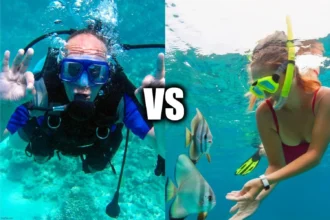
Scuba Diving vs Snorkeling
Both activities allow you to experience the underwater environment, but they are fundamentally different.
| Feature | Snorkeling | Scuba Diving |
|---|---|---|
| Breathing | Surface breathing through snorkel | Breathing underwater through regulator |
| Equipment | Mask, snorkel and fins | Full scuba equipment |
| Training | Usually minimal | Formal training for independent diving |
| Depth | Primarily surface | Can descend significantly deeper |
| Experience | Easy introduction | More immersive underwater experience |
| Planning | Generally simpler | Requires structured dive planning |
Snorkeling can be a great introduction to marine life.
Scuba diving offers a much more immersive experience because you can remain underwater rather than returning to the surface to breathe.
Scuba Diving Mistakes Beginners Should Avoid
Mistake 1: Buying Everything Immediately
You do not need a complete $2,000+ equipment setup before your first course.
Rent first and learn what equipment fits your preferences.
Mistake 2: Choosing the Cheapest Course
Price is important, but instructor quality, group size, equipment condition and training time matter too.
Mistake 3: Ignoring Ear Pressure
If your ears hurt, do not simply keep descending.
Stop and equalize according to your training.
Mistake 4: Swimming Too Hard
Beginners sometimes kick constantly because they are nervous.
Efficient buoyancy and relaxed finning usually make diving easier.
Mistake 5: Touching Marine Life
A photograph is better than a souvenir.
Leave animals, coral and underwater structures undisturbed.
Mistake 6: Diving Beyond Your Experience
A certification card does not automatically make every dive appropriate.
Conditions matter.
Mistake 7: Flying Too Soon After Diving
This is one of the most important travel considerations for divers.
DAN currently recommends a minimum preflight surface interval of 12 hours after a single no-decompression dive and 18 hours after multiple dives or multiple days of diving; substantially longer intervals are advised after decompression dives.
Your dive operator or medical professional may recommend a more conservative interval.
Flying After Scuba Diving
Why is flying after diving a concern?
An aircraft cabin has lower pressure than sea level.
After diving, your body may still contain inert gas absorbed during the dive.
Reducing surrounding pressure too soon can increase decompression stress.
DAN explains that flying after diving increases decompression stress because aircraft cabin pressure is lower than pressure at ground level.
For this reason, do not schedule your final dive immediately before your flight home.
A better travel plan leaves an appropriate surface interval between diving and flying.
How to Choose Your First Dive Destination
Your first dive destination does not have to be the most famous dive site in the world.
For beginners, consider:
Water Conditions
Calm water can make learning easier.
Visibility
Good visibility can reduce anxiety and make the experience more enjoyable.
Water Temperature
Choose conditions appropriate for your exposure protection and comfort.
Instructor Quality
A skilled instructor can be more important than the destination itself.
Emergency Support
Ask what medical and emergency facilities are available nearby.
Group Size
Smaller groups can provide more direct attention during training.
Total Cost
Look at the entire trip—not only the advertised dive price.
What Should You Buy Before Your First Course?
You can usually rent most scuba equipment.
If you want to purchase something early, personal-fit equipment can make sense.
Consider starting with:
- Mask
- Snorkel
- Fins
- Booties, depending on the type of fins and entry conditions
PADI similarly highlights mask, snorkel and fins as personal equipment beginners may want to own.
Wait before buying expensive items such as:
- BCD
- Regulator
- Dive computer
- Drysuit
unless you already understand what you need.
Try rental equipment first and learn your preferences.
Beginner Scuba Diving Checklist
Before your first dive, make sure you understand:
Training
- What course or experience am I taking?
- Who is my instructor?
- What certification agency is involved?
- What skills will I learn?
Equipment
- Does my mask fit?
- Is my regulator functioning?
- Is my BCD working?
- Is my cylinder secure?
- Is my weight system appropriate?
Dive Planning
- What is the maximum depth?
- How long is the planned dive?
- Who is my buddy?
- What are the entry and exit points?
- What happens if conditions change?
Safety
- Do I understand the hand signals?
- Do I know how to equalize?
- Do I know how to respond if my regulator leaves my mouth?
- Do I know what to do if I become uncomfortable?
- Have I discussed any medical concerns?
Frequently Asked Questions
Is scuba diving difficult for beginners?
The basic concepts can be learned by beginners, but scuba diving requires proper training and practice. Skills such as buoyancy control, equalization and underwater communication become easier with experience.
How long does it take to learn scuba diving?
The timeline depends on the certification agency, course structure, instructor and location. Some entry-level courses can be completed in several days, while others may take longer.
What is the first scuba certification?
Open Water Diver is a common entry-level certification. PADI, SSI and other agencies offer their own certification systems.
How deep can an Open Water diver go?
Depth limits depend on the certification agency and local rules. PADI’s Open Water course trains divers to a maximum depth of 18 metres/60 feet.
Can non-swimmers scuba dive?
Water confidence and swimming skills are important, and certification courses have specific water-skill requirements. If you are not comfortable swimming, discuss it honestly with the dive centre before booking.
Do I need to buy scuba equipment?
No. Most beginner courses provide or rent the major equipment. Personal items such as a mask, snorkel and fins can be purchased if you prefer.
Is scuba diving safe?
Scuba diving has risks, but appropriate training, planning, equipment checks, conservative decisions and following established procedures can help manage those risks.
Can I scuba dive without certification?
You may be able to participate in a supervised introductory experience without holding a full certification. Independent recreational diving normally requires appropriate certification and compliance with local/operator requirements.
How long can you stay underwater?
There is no universal time limit. Dive time depends on depth, breathing rate, gas supply, water temperature, equipment, dive planning and other factors.
How long should I wait before flying after scuba diving?
DAN recommends at least 12 hours after a single no-decompression dive and 18 hours after multiple dives or multiple days of diving. Longer intervals may be appropriate depending on the dive profile and circumstances.
What should I do if my ears hurt while descending?
Stop descending. Attempt appropriate equalization according to your training. Do not force equalization. If the problem continues, end the descent and seek guidance from your instructor.
Final Thoughts
Learning how to scuba dive is not about immediately becoming an expert underwater.
It is about building skills one step at a time.
Start with appropriate training. Learn how your equipment works. Practice fundamental skills in controlled conditions. Listen to your instructor. Learn to manage buoyancy and air supply. Respect your limits and the underwater environment.
Most importantly, do not rush your progression.
The ocean will still be there when you are ready for the next level.
Your first scuba dive may introduce you to coral reefs, colourful fish, wrecks, rays, turtles or landscapes that you have only seen in photographs.
But the most valuable thing you take away from proper scuba training is not simply the ability to breathe underwater.
It is the knowledge and judgement to explore that underwater world responsibly.
Ready to start? Begin with a qualified dive centre, choose the right entry-level training and make your first dive an experience you can build on for years to come.